A practical B2B buyer's guide for beauty brands and distributors: how to evaluate LED face mask manufacturers across optical design, customization, compliance and manufacturing quality.

Choosing an LED face mask manufacturer is not simply about comparing wavelengths, LED counts and prices.
Two masks can look similar on a specification sheet but perform very differently in actual use. For beauty brands and distributors developing an OEM or private label LED face mask, the bigger questions are whether the manufacturer understands optical design, can support meaningful customization, provides reliable testing and compliance documentation, and can reproduce the approved performance in mass production. 6-Color LED Facial Mask
Here are the key areas B2B buyers should evaluate before choosing a manufacturing partner.
How to choose an LED face mask manufacturer: hero image showing LED mask with engineering and compliance icons
Before asking a supplier for its “best LED mask,” define what you are actually trying to build.
Consider:
A lightweight open-frame mask, flexible silicone mask and face-and-neck system serve different consumers and price segments.
A capable LED mask manufacturer should help translate your product positioning into a realistic specification instead of simply recommending whichever model it wants to sell.
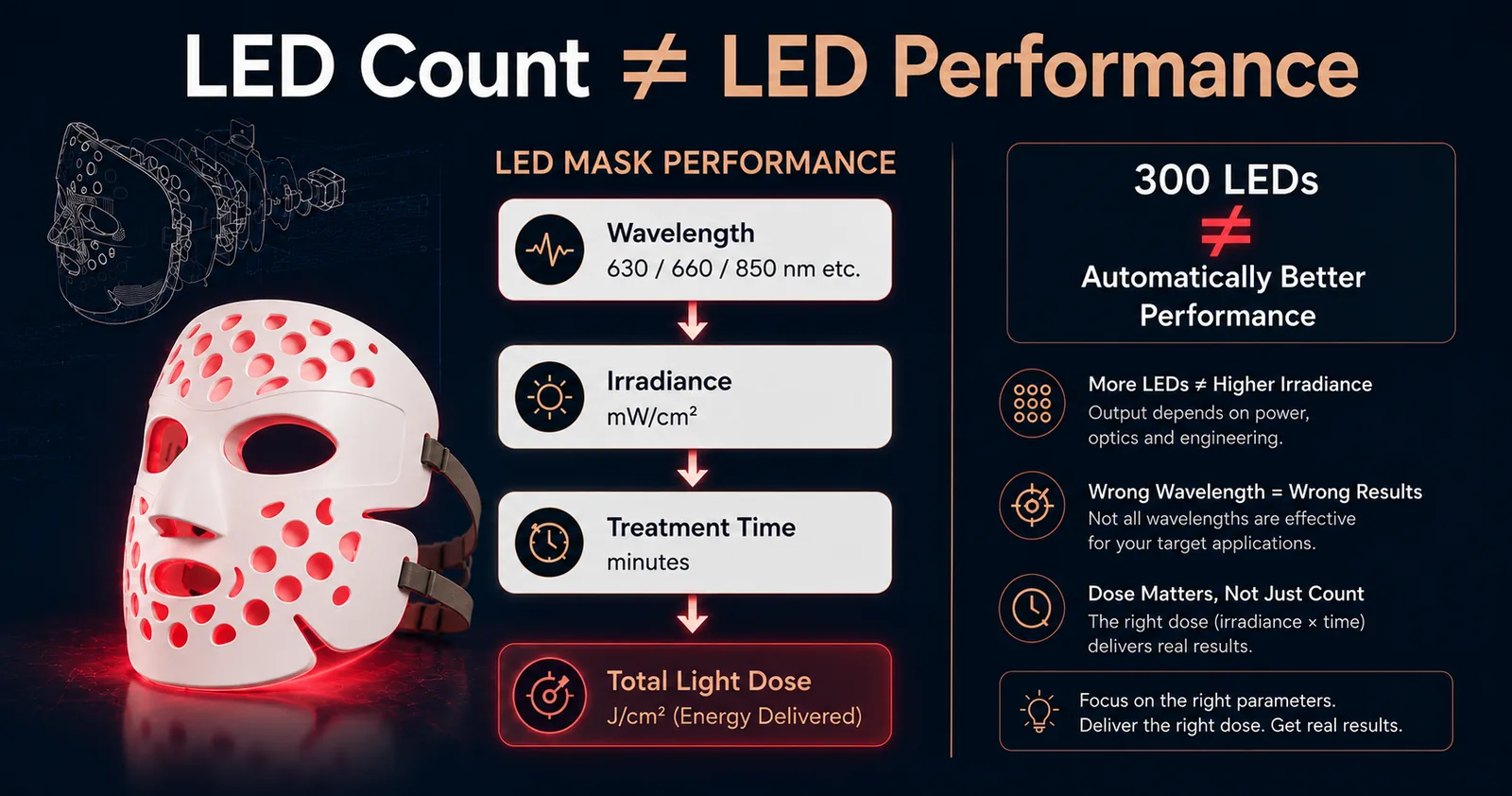
LED Count is not LED Performance: wavelength, irradiance, treatment time and total light dose explained
“240 LEDs” or “368 light beams” may sound impressive, but LED quantity alone tells you little about actual performance.
Three parameters deserve more attention.
Common wavelengths include red light around 630–660 nm, near-infrared around 830–850 nm, blue around 415–460 nm and yellow or amber around 590 nm.
Ask for the actual wavelength specification and tolerance. For example, 630 ±10 nm provides more useful information than simply stating “red light.”
Irradiance indicates the optical power delivered over a given area, usually expressed in mW/cm².
Without irradiance data, comparing two masks based only on wavelength and LED quantity is incomplete.
Light dose depends on irradiance and treatment time.
A useful way to evaluate the system is:
Wavelength + Irradiance + Treatment Time → Treatment Protocol
A manufacturer that understands this relationship usually provides more technical value than one focused mainly on LED quantity or the number of colors.
See the 6-color LED facial mask in action.
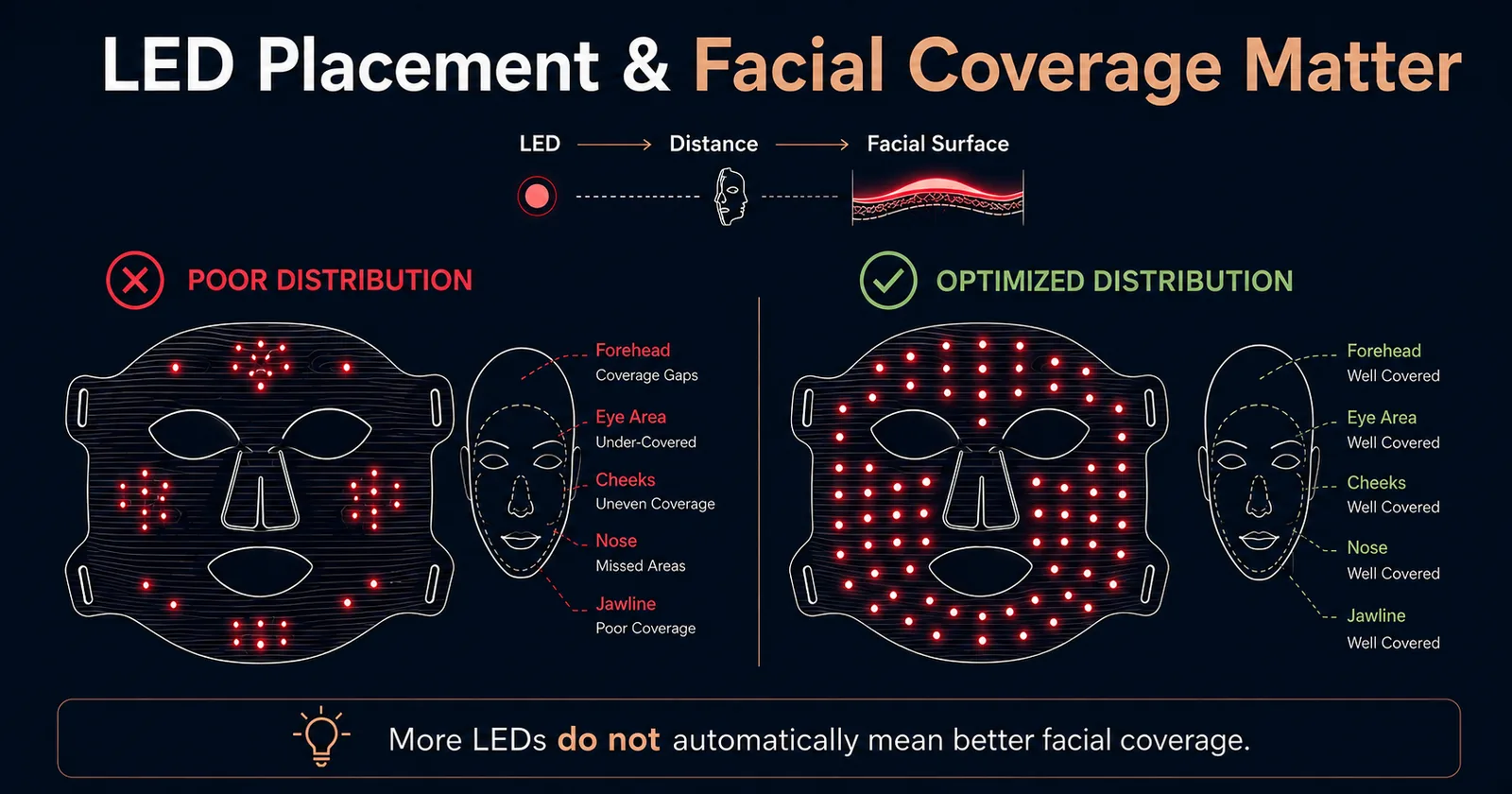
LED placement and facial coverage matter: poor versus optimized LED distribution across the face
High irradiance at one measurement point does not mean the entire face receives consistent exposure.
Mask structure, LED placement, facial curvature and the distance between the LEDs and skin all affect coverage.
When evaluating samples, pay particular attention to:
Ask how the manufacturer measures irradiance and whether measurements are taken at multiple facial positions rather than only at the strongest point.
The better question is not:
“Which mask has more LEDs?” It is:
“How effectively does the optical design distribute light across the intended treatment area?”
Optical specifications matter, but consumers still need to wear the device consistently.
A technically strong mask can create a poor user experience if it is too heavy, puts pressure on the nose or face, traps excessive heat or feels uncomfortable around the eyes.
Evaluate:
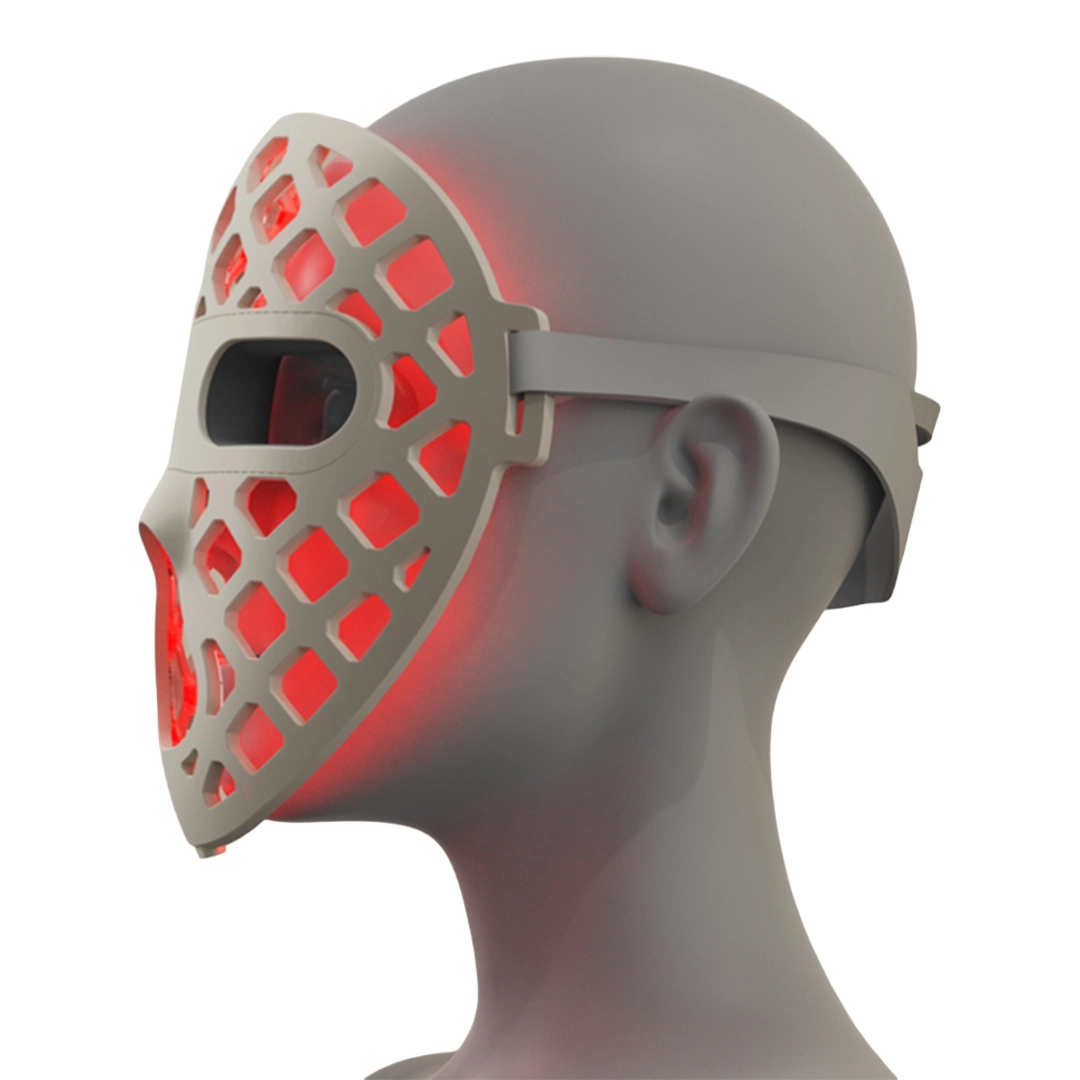
Different structures solve these problems differently. Flexible silicone masks prioritize close facial contact, while an open-frame LED mask can reduce facial pressure and improve airflow. Ultra-Light Hollow LED Therapy Facial Mask
A lightweight open-frame design built for comfortable wear.
Neither is automatically better. The right architecture depends on your consumer and brand positioning.
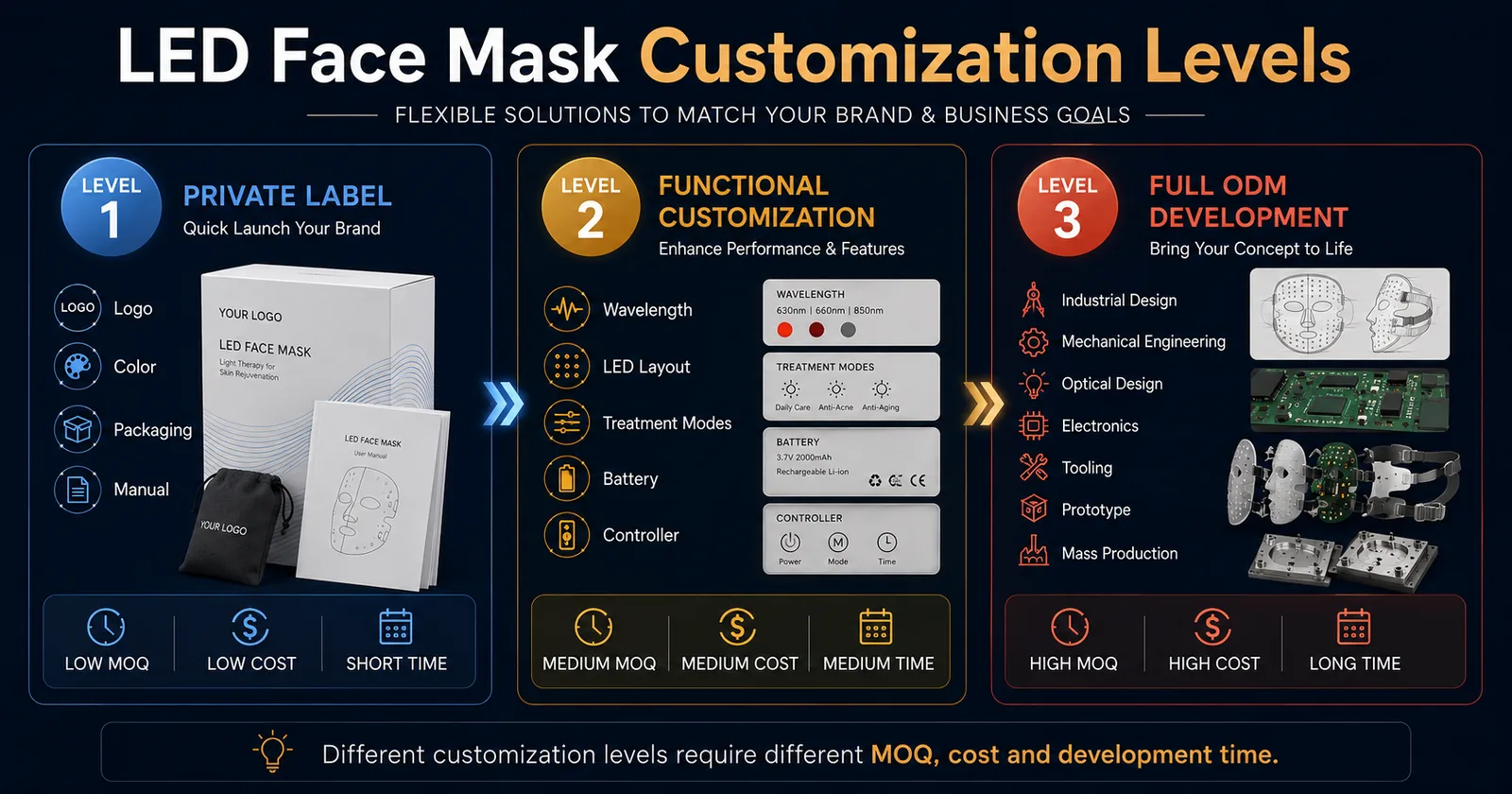
LED face mask customization levels: private label, functional customization and full ODM development compared
Many suppliers describe themselves as OEM/ODM manufacturers when their customization capability is limited to logo, color and packaging.
For B2B buyers, it helps to separate customization into three levels.
Logo, product color, packaging, manual and accessories.
This is usually the fastest route for brands testing the market.
Depending on the product platform, this may include wavelength combinations, LED configuration, treatment modes, controller design, battery specifications and operating logic.
More differentiated projects may involve industrial design, mechanical engineering, new mask structures, optical layout, electronics, tooling, prototyping and production validation.
A genuine OEM LED face mask manufacturer should explain clearly what can be changed on an existing platform and what requires new engineering, tooling, MOQ and development cost.
For brands building a long-term product line, this distinction is far more important than whether a supplier can print a logo.
Do not ask only:“Do you have FDA or CE?” Compliance depends on the product design, intended claims and destination market Instead, request documentation relevant to the actual model. Depending on the project, this may include:
Claims also matter. A cosmetic skincare device and a product making medical treatment claims may follow different regulatory pathways.
A reliable manufacturer should understand this distinction rather than claiming that one certificate makes a product suitable for every market.
Compliance does not automatically prove product efficacy.
If performance is central to your positioning, ask what additional testing or validation is available.
This may include:
Be particularly careful with claims such as “clinically proven” or “medical grade.” Ask what evidence supports the claim and whether it applies to the actual model you are purchasing.
For a brand, precise data with clear limitations is more useful than an impressive marketing claim that cannot be verified.
A good engineering sample does not guarantee consistent mass production.
The manufacturer should have defined controls covering:
IQC → IPQC → Aging / Functional Testing → FQC
For an LED face mask, inspection should cover areas such as LED function, optical output, electronics, battery and charging, controller operation, assembly, appearance and finished-product functionality.
Also ask how defects are traced and handled after shipment.
The objective is not to find a factory claiming a “zero defect rate.” It is to find one with a system capable of detecting, tracing and correcting problems before they become large production issues.
The lowest unit quotation does not necessarily mean the lowest project cost.
Evaluate:
For a new brand validating demand, an existing platform with moderate customization may offer a better return than immediately investing heavily in tooling.
For an established brand developing a hero product, deeper technical and structural customization may justify the additional investment.
The right decision depends on your stage, volume and differentiation strategy.
Before mass production, test more than whether the LEDs turn on. Evaluate:
For OEM/ODM projects, agree on a specification sheet and keep the approved sample as the production reference.
This turns sample approval from a subjective decision into a measurable quality benchmark.
| Area | What to Verify |
|---|---|
| Product Strategy | Does the architecture fit your target consumer? |
| Light System | Are wavelength, irradiance and treatment time specified? |
| Coverage | Is light distributed effectively across the face? |
| Wearability | Is the mask comfortable for repeated use? |
| Customization | Can the supplier go beyond logo and packaging? |
| Compliance | Are reports relevant to the actual model and market? |
| Validation | Are performance claims supported by testing? |
| Manufacturing | Are quality-control procedures clearly defined? |
| Commercial Terms | Are MOQ, tooling, development cost and lead time transparent? |
Choosing an LED face mask manufacturer is ultimately a product-development and risk-management decision, not simply a sourcing exercise. Anti-Aging LED Light Therapy Mask & Neck Set
A strong manufacturing partner should connect:
Product Concept → Optical & Engineering Design → Validation → Mass Production
For brands entering the market quickly, a validated private-label platform may be the most efficient option. For brands seeking stronger differentiation, the key question is whether the manufacturer can develop the product around a specific consumer experience, technical specification and market position.
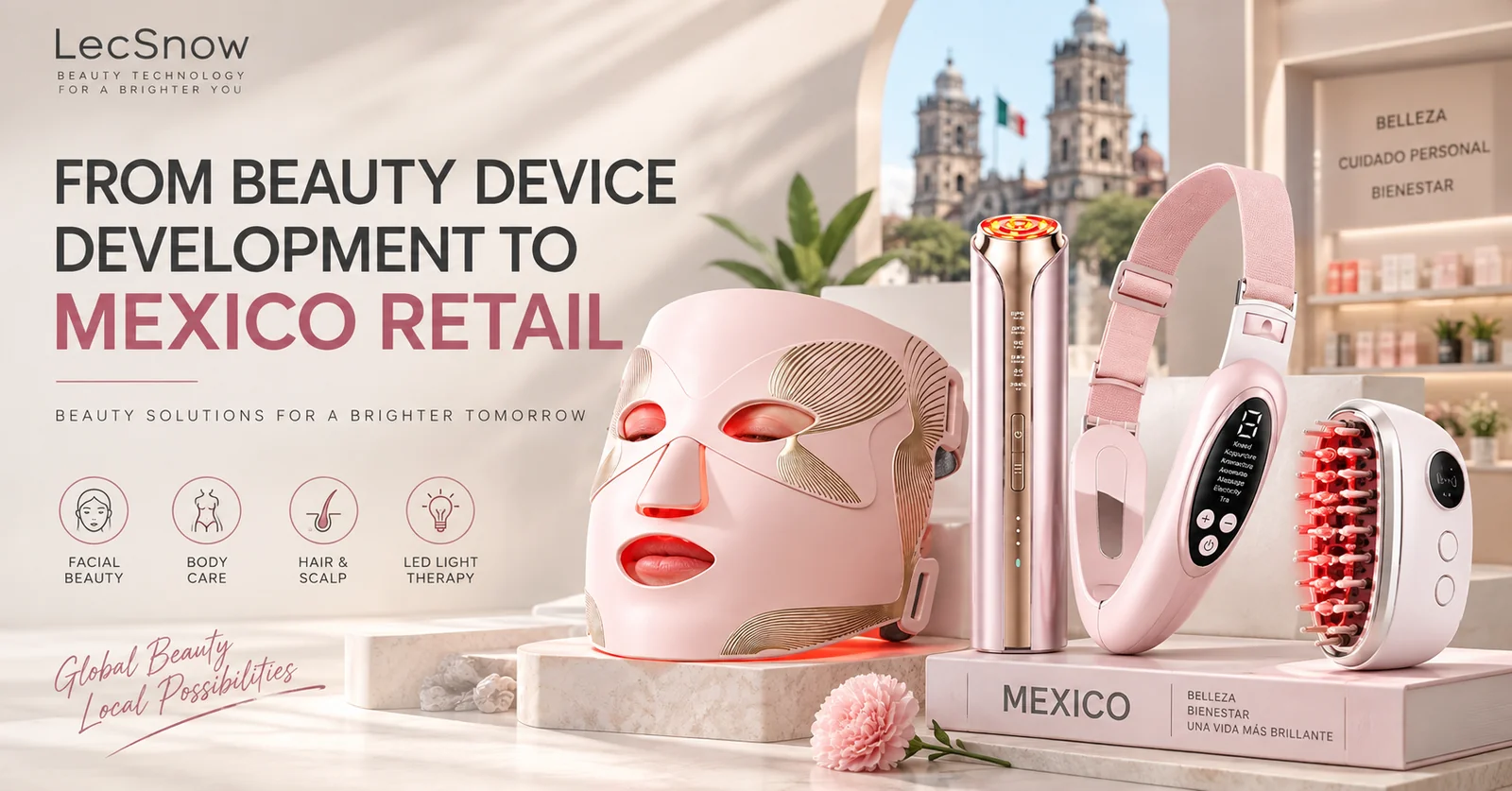
At LecSnow, we develop and manufacture LED light therapy devices for beauty and wellness brands, supporting both private-label projects and deeper OEM/ODM development. Our LED platforms include flexible, lightweight open-frame and extended face-and-neck designs for different brand strategies and market requirements.
Learn about LecSnow’s manufacturing and R&D capabilities.
Ultra-Light Hollow LED Therapy Facial Mask
Anti-Aging LED Light Therapy Mask & Neck Set
The goal should not be to launch another similar LED mask, but to build one with a clear reason for consumers to choose it.
Whether launching your first product or scaling your next bestseller, LecSnow is here to bring your vision to life faster, smarter, and without compromise.