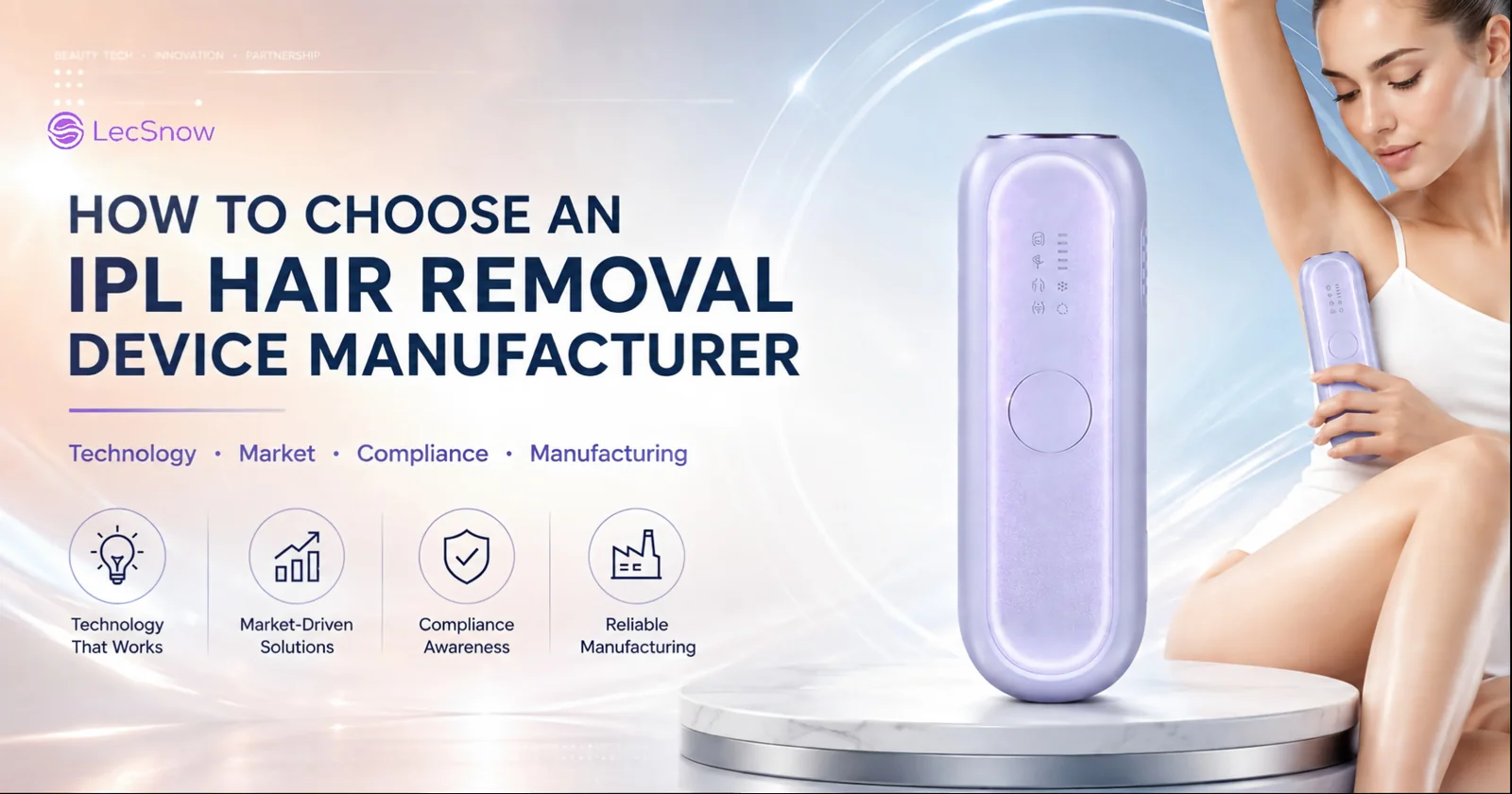
Choosing an IPL hair removal device manufacturer should start with one question: what kind of IPL product are you actually trying to sell?

A brand targeting an entry-level online market should not select its product using the same criteria as a premium beauty brand. The required lamp, cooling system, optical architecture, driving solution, regulatory route and manufacturing cost can be very different.
This is why comparing an OEM IPL manufacturer only by price, maximum joules or claimed flash life often leads to the wrong decision. A better approach is to define your target market and retail position first, choose the right technical platform second, and then evaluate whether the IPL hair removal device supplier can deliver that platform consistently in mass production.
Before asking an IPL manufacturer for recommendations, define the commercial framework of the project. At minimum, clarify:
This information changes the product recommendation significantly. If your brand is entering a highly price-sensitive market, investing in sapphire cooling or a completely new housing may not create enough commercial return. If you are building a premium product, however, another basic IPL with only a different logo and color may leave too little room for differentiation.
The manufacturer should therefore recommend a technical platform that fits your target selling price and market position, rather than simply pushing its newest or most expensive model.
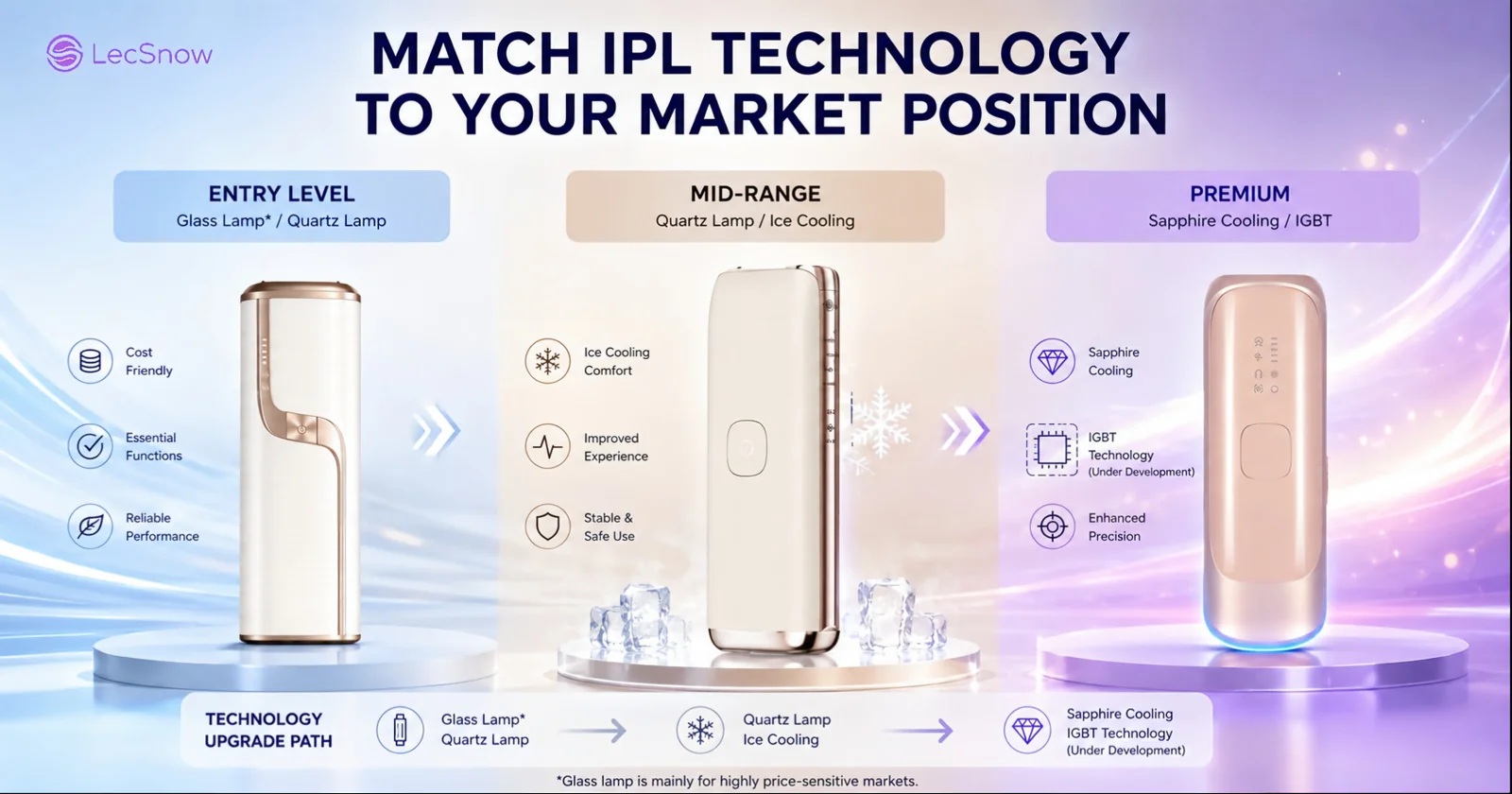
Different lamp, cooling and driving solutions can create substantial differences in product cost and user experience. An experienced IPL hair removal device manufacturer should therefore be able to offer different technical routes rather than recommending the same configuration to every brand.
If the target market is extremely price-sensitive, a mature glass-lamp IPL platform can be considered. Its main advantage is cost, allowing the BOM and final retail price to remain under tighter control.
If the market is not extremely price-sensitive, however, we would generally recommend starting with a quartz lamp. The objective should not be to find the cheapest IPL available, but the lowest-cost configuration that still supports acceptable performance, reliability and brand positioning.
Typical direction: extremely price-sensitive market -> glass lamp; regular entry-level market -> quartz lamp.
For the mainstream mid-range market, a quartz lamp IPL hair removal device provides a solid foundation. Brands that want a more noticeable user-experience advantage can move further into an ice-cooling IPL hair removal device using a semiconductor cooling solution.
When selecting an ice cooling IPL hair removal device supplier, do not compare products simply by the lowest advertised cooling temperature. What matters is whether the cooling system can maintain useful skin-contact cooling while IPL is continuously flashing.
The complete thermal system should be evaluated, including semiconductor cooling capacity, cooling plate contact area, IPL heat generation, heat dissipation, continuous flash frequency and thermal protection.
Typical direction: mid-range -> quartz lamp; mid-to-upper-mid-range -> quartz lamp plus semiconductor ice cooling.
For brands targeting the premium market, two technical directions deserve particular attention: sapphire cooling and IGBT-based solution.
A sapphire IPL hair removal device can provide a more premium cooling and treatment interface. However, when evaluating a sapphire IPL hair removal device manufacturer or supplier, buyers should look beyond the sapphire component itself. The cooling module, optical architecture, thermal management and continuous-treatment performance still determine the overall result.
Another direction is IGBT-controlled IPL. Compared with simply competing through a higher maximum-energy number, an IGBT architecture can create more room for controlled pulse and energy-delivery strategies. LecSnow is currently developing IGBT-based IPL platforms. Our focus is on validating pulse control, energy stability, thermal performance and the resulting treatment experience before positioning the platform as a mature commercial solution.
For brands looking for an IGBT IPL hair removal device supplier, the important question is what measurable performance improvement the architecture creates - not simply whether 'IGBT' appears on the specification sheet.
Typical direction: premium -> sapphire cooling IPL; premium / next-generation development -> IGBT IPL.
Energy is one of the most frequently compared IPL specifications, but a maximum energy number alone tells you very little. Buyers should ask for:
Two products may claim similar maximum energy while one maintains much more consistent output during continuous treatment. This matters because consumers do not use an IPL device for one flash; a treatment session may involve hundreds of flashes.
A useful supplier evaluation should therefore include repeated-flash and thermal testing, not only a single maximum-output measurement.
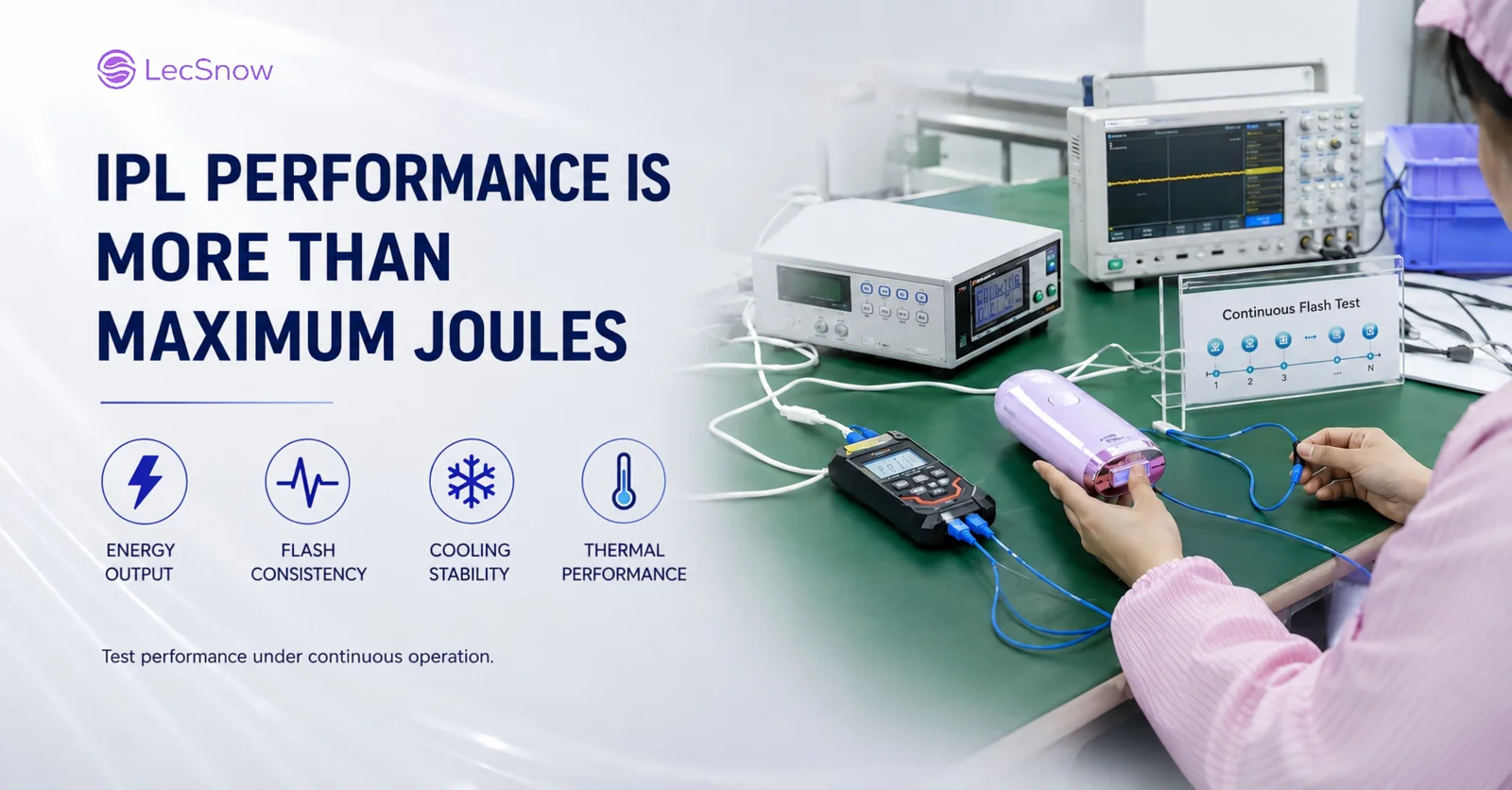
One common sourcing mistake is evaluating the lamp, cooling system and flash speed independently. In reality, they interact.
Repeated IPL flashing generates heat. Cooling also requires heat dissipation. Increasing flash frequency can further increase thermal load. A well-designed device therefore needs to balance optical output, flash speed, cooling and internal thermal management.
When testing a sample, run it as a consumer would. Check whether flash speed decreases during continuous operation, the housing becomes excessively hot, cooling becomes weaker, thermal protection activates frequently, or performance changes after extended flashing.
For an ice-cooling or sapphire IPL, test IPL and cooling simultaneously. Testing the cooling function alone does not represent actual treatment conditions.
Regulatory planning should begin before the final product, packaging and marketing claims are fixed. Requirements differ by destination market, and the exact route depends on the final device configuration, intended use and claims.
For home-use light-based hair removal devices, FDA 510(k) clearance is a key market-entry consideration. For example, Ulike's UI04 series is listed in the FDA 510(k) database under K233679 as a Light Based Over-The-Counter Hair Removal device.
Buyers should distinguish FDA establishment registration from FDA 510(k) clearance for the device. They are not the same. If a supplier claims that an IPL model is FDA cleared, ask for the 510(k) number and verify the exact model coverage in the FDA database.
For the EU, IPL hair-removal equipment should not be treated as a simple request for a generic CE certificate. EU MDR 2017/745 Annex XVI explicitly includes high-intensity electromagnetic radiation equipment, including intense pulsed light equipment for hair removal, among products without an intended medical purpose that are nevertheless subject to the MDR framework. Common Specifications under Regulation (EU) 2022/2346 also apply to this Annex XVI product group.
The conformity-assessment route, technical documentation, applicable standards and CE-marking requirements should therefore be confirmed for the final product and intended use.
For Japan, do not assume that 'IPL = PSE' as a blanket rule. PSE applicability must be evaluated according to the actual electrical architecture and regulated components. For example, AC/DC power supplies and certain lithium-ion batteries can fall within Japan's Electrical Appliances and Materials Safety Act requirements.
If Japan is a target market, confirm the applicable requirements for the complete product configuration and its supplied electrical components before production.
For Thailand, first determine the applicable Thai FDA pathway and risk classification for the final product. Thai FDA uses a four-class risk-based medical-device framework aligned with the ASEAN Medical Device Directive, and registration requirements vary by classification.
For a Thailand project, the manufacturer should be able to support the product owner or local importer with technical documentation, product specifications, labeling/IFU information and other dossier materials required for the applicable registration route.
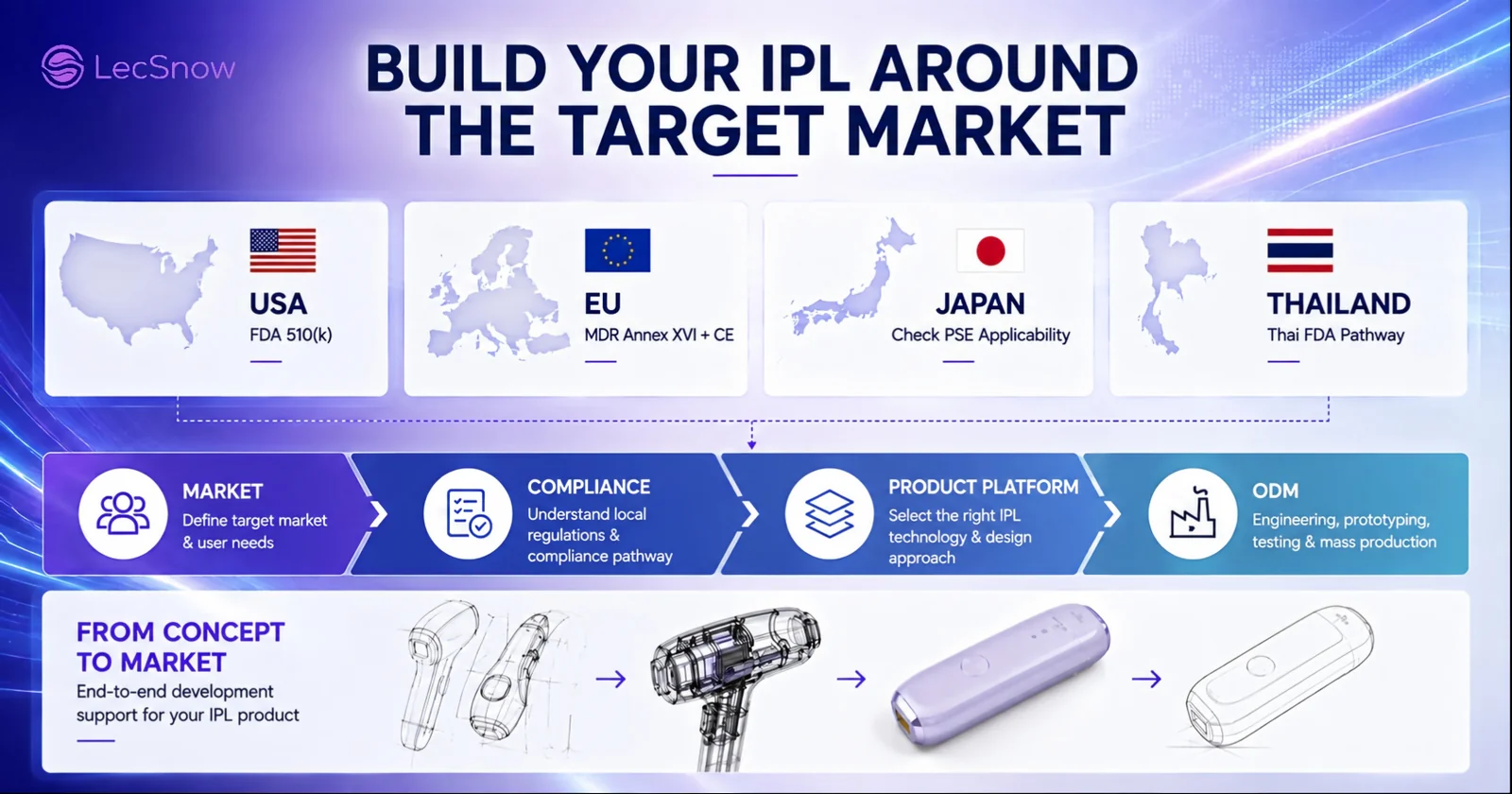
'OEM/ODM' appears on almost every beauty-device supplier website, but the actual capability varies significantly.
For a mature IPL platform, private-label customization can include logo, housing color, packaging, manual and accessories. This is often the right route for a brand validating a new market.
For greater differentiation, semi-ODM development may include a modified housing, treatment window, cooling structure, software logic, energy levels, flash modes or user interface.
Full ODM can go further into industrial design, mechanical structure, electronics, optical architecture and tooling.
Deeper customization is not automatically better. It needs to match expected sales volume, retail positioning, development budget and launch timing.
A specially prepared sample tells you that the manufacturer can make one good device. It does not prove that thousands of units will perform consistently.
For IPL production, buyers should understand how the manufacturer controls incoming lamps and optical components, PCB and capacitor quality, energy output, cooling performance, skin-contact sensors, temperature protection, aging, appearance and final function.
One particularly useful question is: Which critical performance parameters are tested on every device, and which are controlled through sampling?
Also ask about historical after-sales issues. Flash failure, unstable output, overheating, cooling failure, sensor problems and power-system failures can become expensive once thousands of units are in the market.
IPL hair removal is a mature product category for LecSnow. Rather than offering only one standard IPL model, we can support different technical routes according to the brand's target market, retail positioning, budget and required level of differentiation.
Our current IPL development and manufacturing options cover cost-sensitive glass-lamp platforms, quartz-lamp IPL devices, semiconductor ice-cooling IPL devices, premium sapphire-cooling platforms, private-label and ODM customization, with IGBT-based IPL platforms currently under development.
This gives brands more flexibility. A new brand entering a price-sensitive market may achieve a better return by starting from a mature quartz-lamp platform and differentiating through product design, color, packaging and brand experience. An established beauty brand targeting a higher retail price may instead prioritize stronger cooling, sapphire contact, faster treatment experience or deeper hardware customization.
Because IPL is already a mature category for us, development does not necessarily need to start from zero. Depending on the project, we can work from an existing mature platform and modify the areas that create meaningful differentiation. This can reduce unnecessary development cost and shorten development time while retaining more resources for the features customers will actually notice.
For projects requiring deeper differentiation, LecSnow can also support ODM development involving industrial design, mechanical structure, electronics, optical configuration, cooling architecture and software logic.
Whether you are looking for an IPL hair removal device manufacturer, ice cooling IPL hair removal device supplier, sapphire IPL hair removal device manufacturer, or exploring an IGBT IPL hair removal device ODM solution, the starting point should be the same: define the market and product positioning first, then build the technical solution around it.
Before placing a production order, do not simply ask which sample feels better. Create a comparison based on your intended market.
The best sample is not necessarily the product with the highest specifications. It is the product with the strongest combination of performance, cost, differentiation, compliance and expected retail value for your specific market.
1. Which IPL platform matches our target retail price and market position?
2. What lamp, optical window and cooling architecture does it use?
3. What is the actual energy output and how is it measured?
4. How stable is the device during continuous flashing?
5. What happens to cooling performance during extended treatment?
6. Which regulatory documents are available or required for our target market?
7. What can be customized without rebuilding the entire product?
8. Which critical parameters are controlled during mass production?
9. What are the most common historical failure modes?
10. Can the manufacturer support future ODM development if the product succeeds?
Choosing an IPL manufacturer is ultimately not about finding the supplier with the longest specification sheet.
It is about selecting the right technical platform for your price segment and target market, then working with a manufacturer capable of turning that platform into a reliable, compliant and differentiated commercial product.
Whether launching your first product or scaling your next bestseller, LecSnow is here to bring your vision to life faster, smarter, and without compromise.