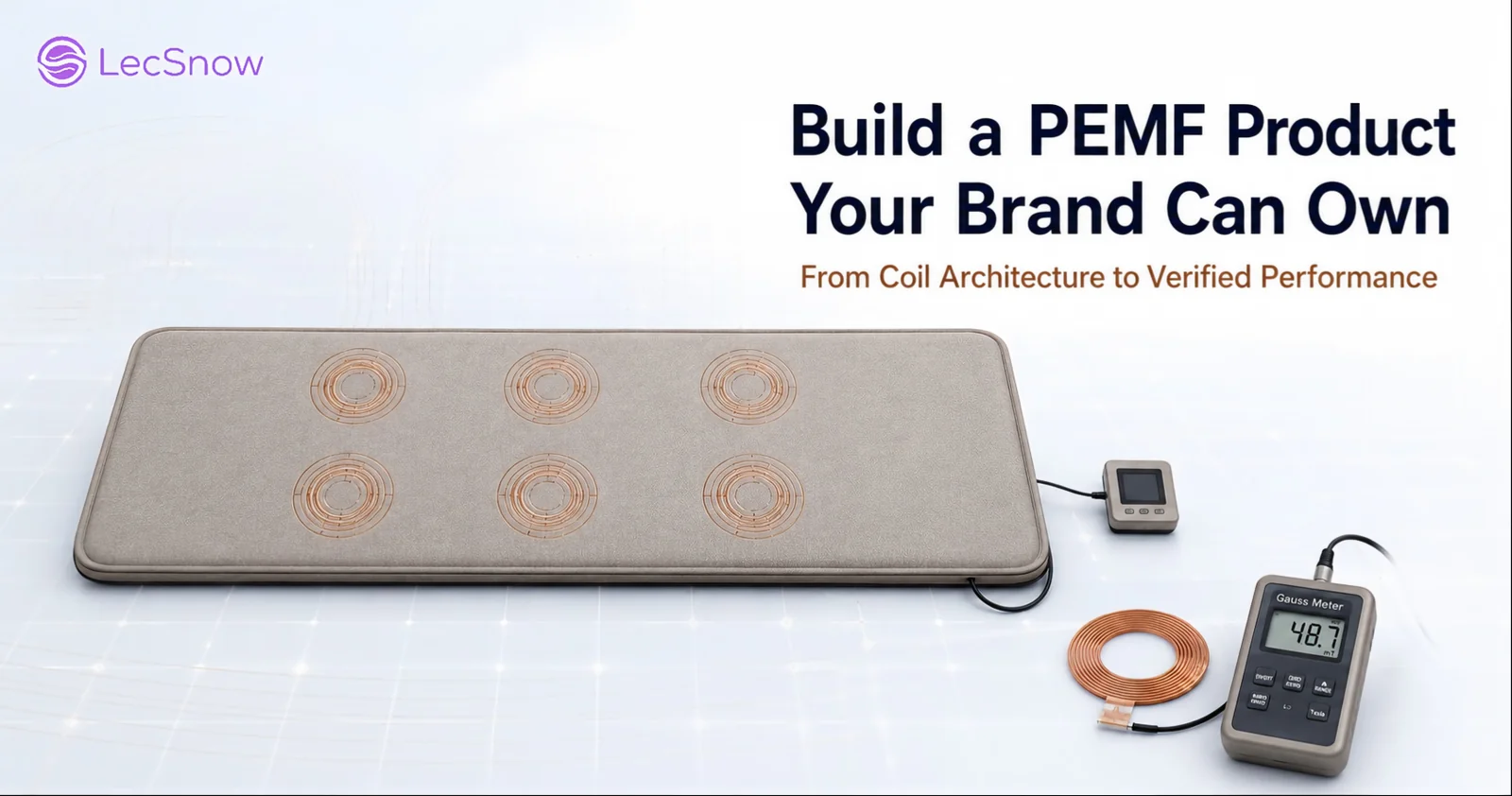
Developing a differentiated PEMF mat requires more than changing the logo or increasing the Gauss specification. This guide explains how wellness brands should evaluate coil design, waveform, testing, compliance and future product-line expansion.

Market positioning, coil development, performance testing and OEM/ODM compliance planning
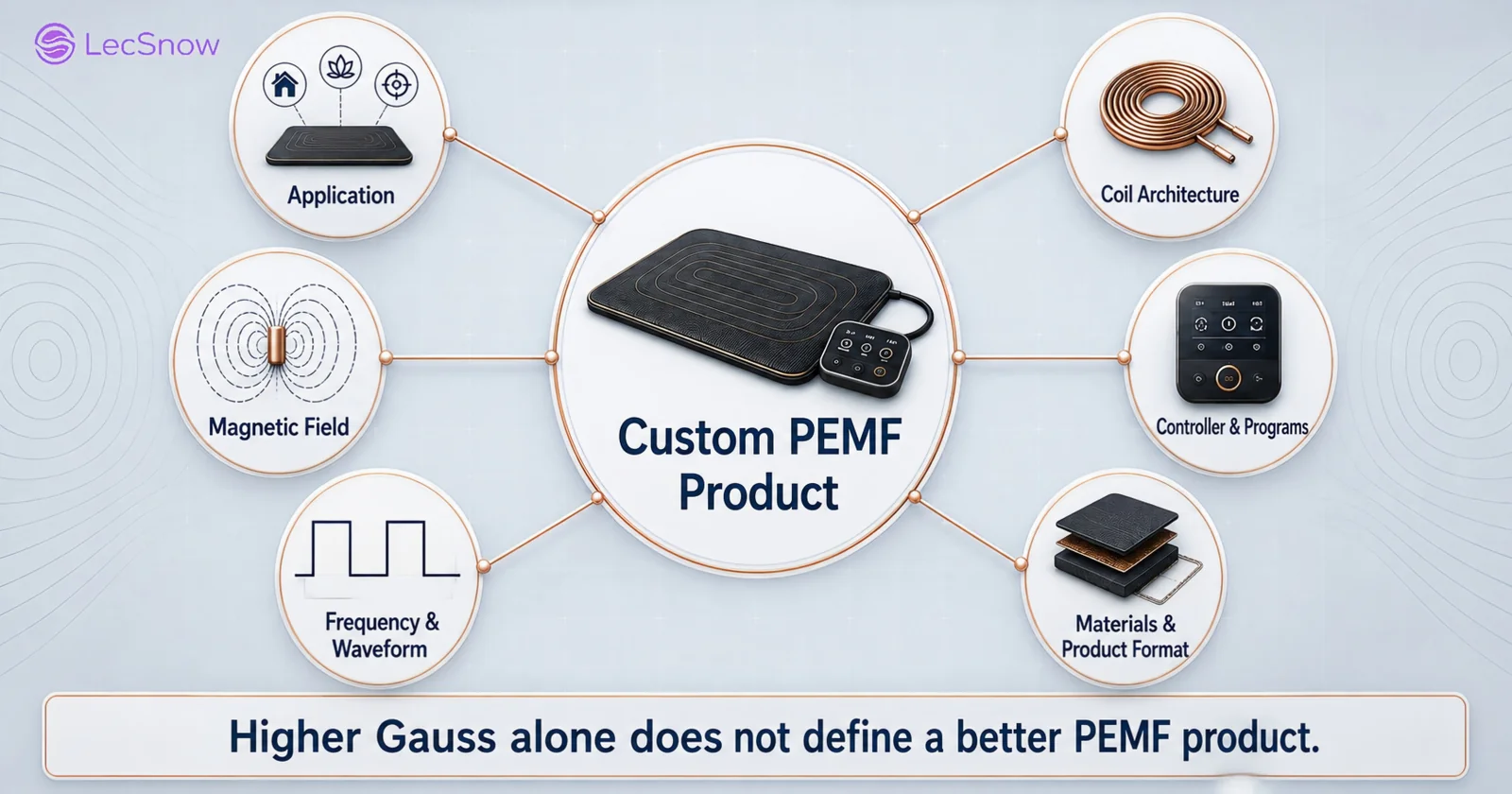
For wellness brands searching for a customized solution for a PEMF mat, the real challenge is not finding a standard product. It is determining which combination of magnetic field strength, frequency, waveform, coil design, controller, materials and product format can create a commercially differentiated system.
As a PEMF mat OEM/ODM manufacturer, LecSnow works with brands to develop full-body PEMF mats, targeted PEMF therapy devices and animal-use solutions. Our role goes beyond logo and packaging customization. We help customers translate a market opportunity into a defined product, test its core performance and prepare it for repeatable production.
PEMF is moving beyond a specialist technology category and becoming part of the wider home wellness, recovery and longevity market. One commercial estimate projects the global pulsed electromagnetic field therapy device market to grow from approximately USD 551 million in 2025 to USD 800 million by 2031, representing a CAGR of around 6.4%. Exact estimates vary because some reports cover PEMF products specifically, while others include a wider range of electromagnetic therapy devices.
The more useful signal is the number of distinct strategies already visible in the category. CELLER8 emphasizes portability and combined full-body and localized applications. BEMER focuses on low-intensity systems and human and equine product formats. iMRS Prime offers full-body mats, targeted applicators and configurable programs, while HigherDOSE combines PEMF with infrared heat and lifestyle-oriented product design.
These brands are not competing through Gauss output alone. They combine different technologies, product formats, programs, materials, user experiences and market positions. A new wellness brand should therefore ask which product architecture fits its own customer, price point and future product line—not which existing product can be copied most quickly.
During our cooperation with a US-based premium wellness technology company, we observed how an experienced brand approaches an emerging product category. The company closely monitors new wellness technologies, but moves forward only when a new direction makes sense for both its customers and its broader product portfolio.
Before placing the initial PEMF order, the brand compared different product and supplier options and evaluated the opportunity from several angles—including technology, product quality, customization potential, development support and overall fit with its wellness strategy. Once these factors aligned, the brand moved forward with the initial order and began exploring how the platform could be further adapted to its own brand.
Its objective was not simply to add another PEMF mattress to its catalogue. The company wanted a product that could be clearly connected to its own brand positioning and future recovery portfolio. A standard platform can provide a useful starting point, but an unchanged model leaves less room to build recognizable product value or protect a premium price. The project therefore focused on defining which performance, structural and experience elements should become specific to the brand.
We see similar priorities in other inquiries for custom PEMF mats and private-label pulsed electromagnetic field devices. Buyers increasingly ask about:
Before defining technical parameters, a PEMF device manufacturer needs to understand who will use the product, where it will be used, whether it requires full-body or targeted coverage, its target retail price, and whether it will be positioned for general wellness or follow a medical-device pathway.
A portable home mat may prioritize low weight, simple programs and easy storage. A premium full-body PEMF mattress may require wider coverage, multiple coils and a more advanced controller. A targeted device may prioritize field concentration around a specific area. Each format requires a different balance of intensity, frequency, waveform, coverage and usability.
A higher Gauss number does not automatically create a better product. A value measured directly on the coil surface cannot be compared fairly with a value measured 1, 3, 5 centimeters away. A responsible PEMF mat supplier should state the measurement position, distance, program and instrument—not only the largest available number.
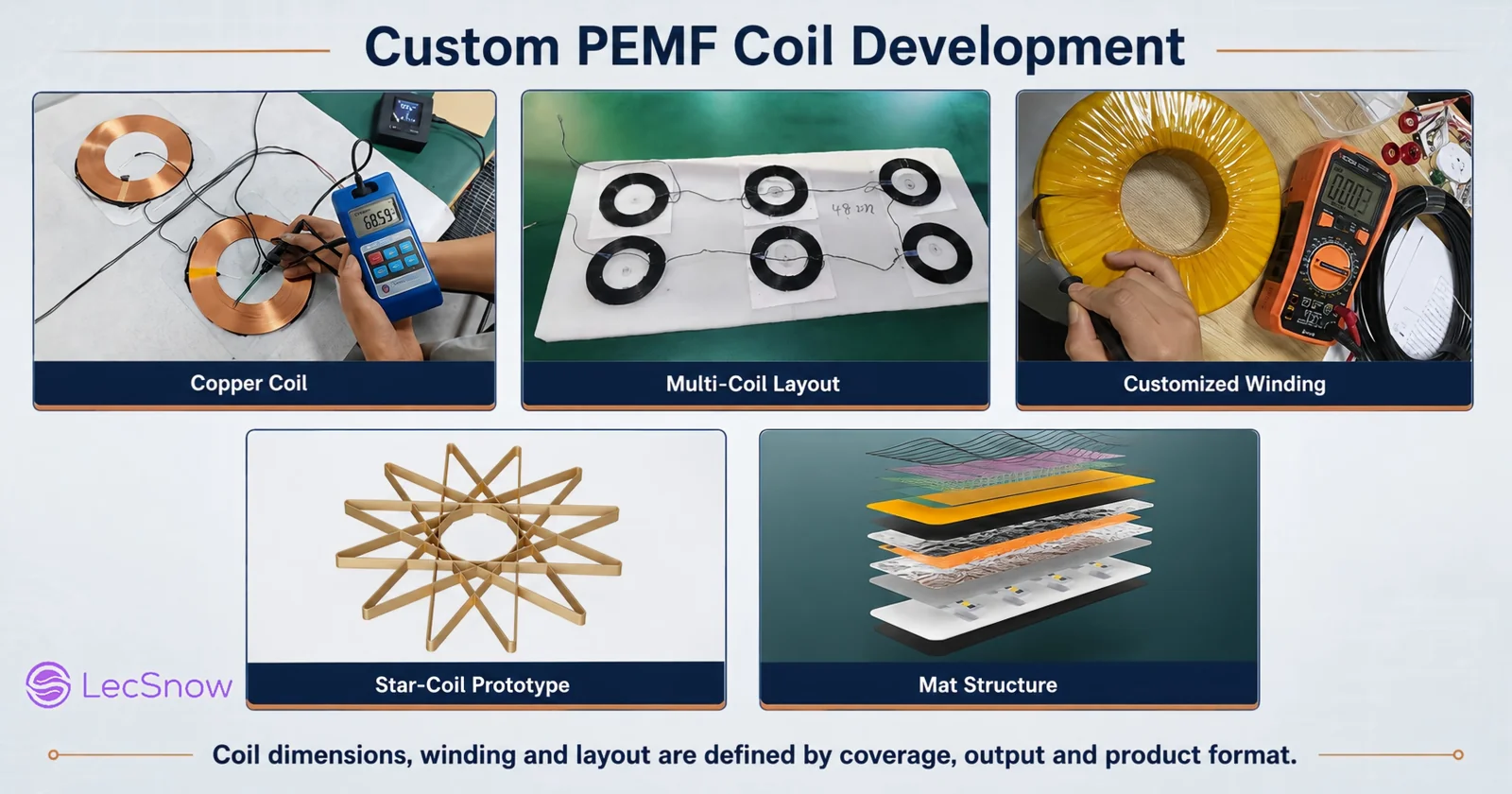
A custom PEMF coil design may involve changes to shape, diameter, winding structure, wire specification, quantity, positioning and connection method. These choices influence field strength, distribution, electrical load, heat generation, product thickness and coverage.
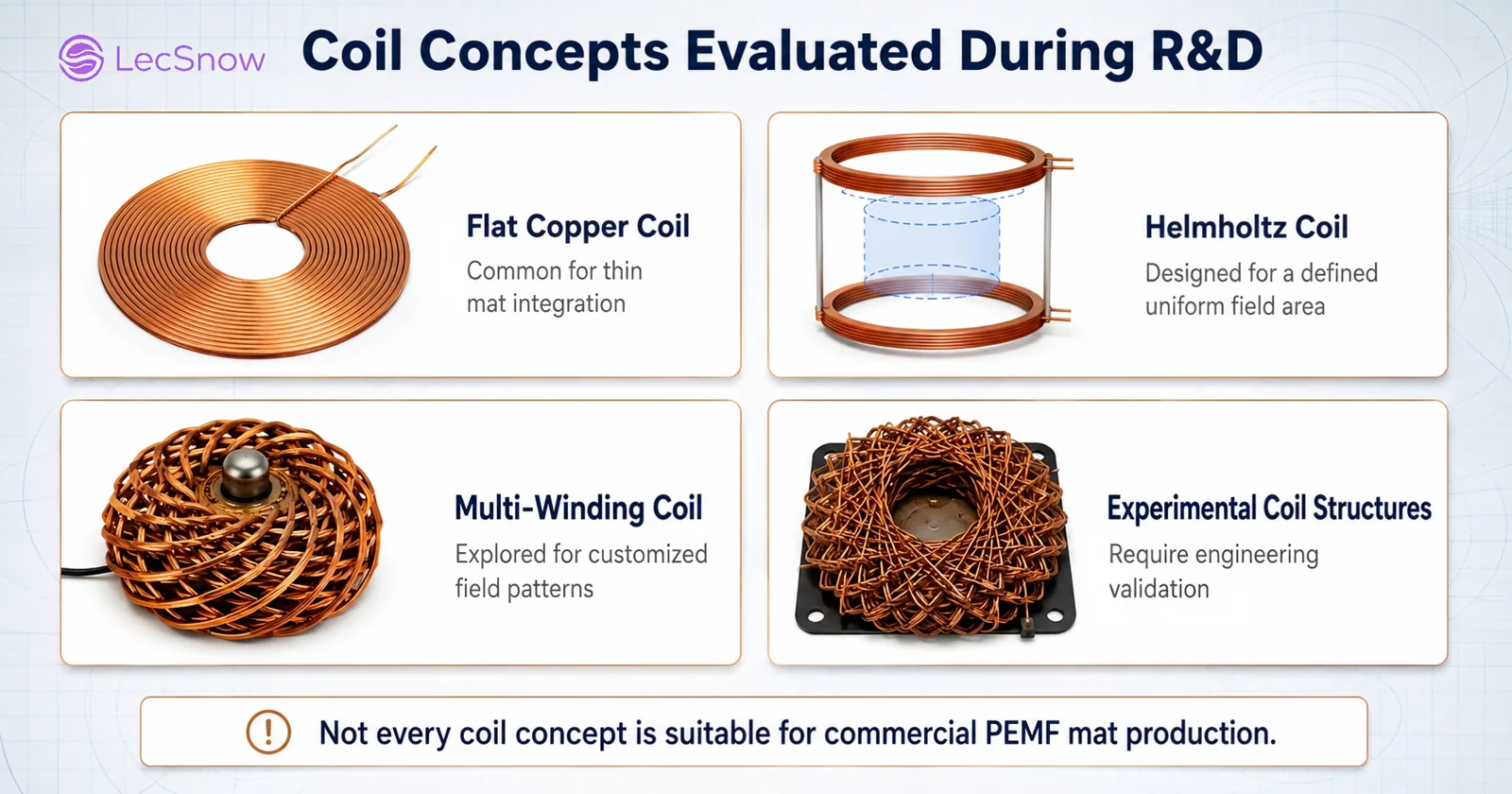
Flat copper coils are commonly used in thin mats; series-connected coils can support multi-zone layouts; star and multi-winding structures may be explored for customized field patterns; Helmholtz coils are designed around a relatively uniform field within a defined space; and Rodin-style or bird’s-nest structures may be assessed for specialized concepts. Tesla-coil structures use a different technical principle and should not be treated as equivalent to conventional low-frequency PEMF mat coils.
Not every visually distinctive coil is suitable for commercial production. The final selection must balance magnetic performance, safety, stability, flexibility, cost and production consistency.
LecSnow copper coils, multi-coil layouts and customized coil prototypes used during PEMF development.
Examples of additional coil concepts. Commercial selection depends on measurable performance and the intended product architecture.
A PEMF mat cannot be evaluated reliably from its appearance, marketing description or controller display. A structured plan should verify whether the finished product delivers the defined specification.
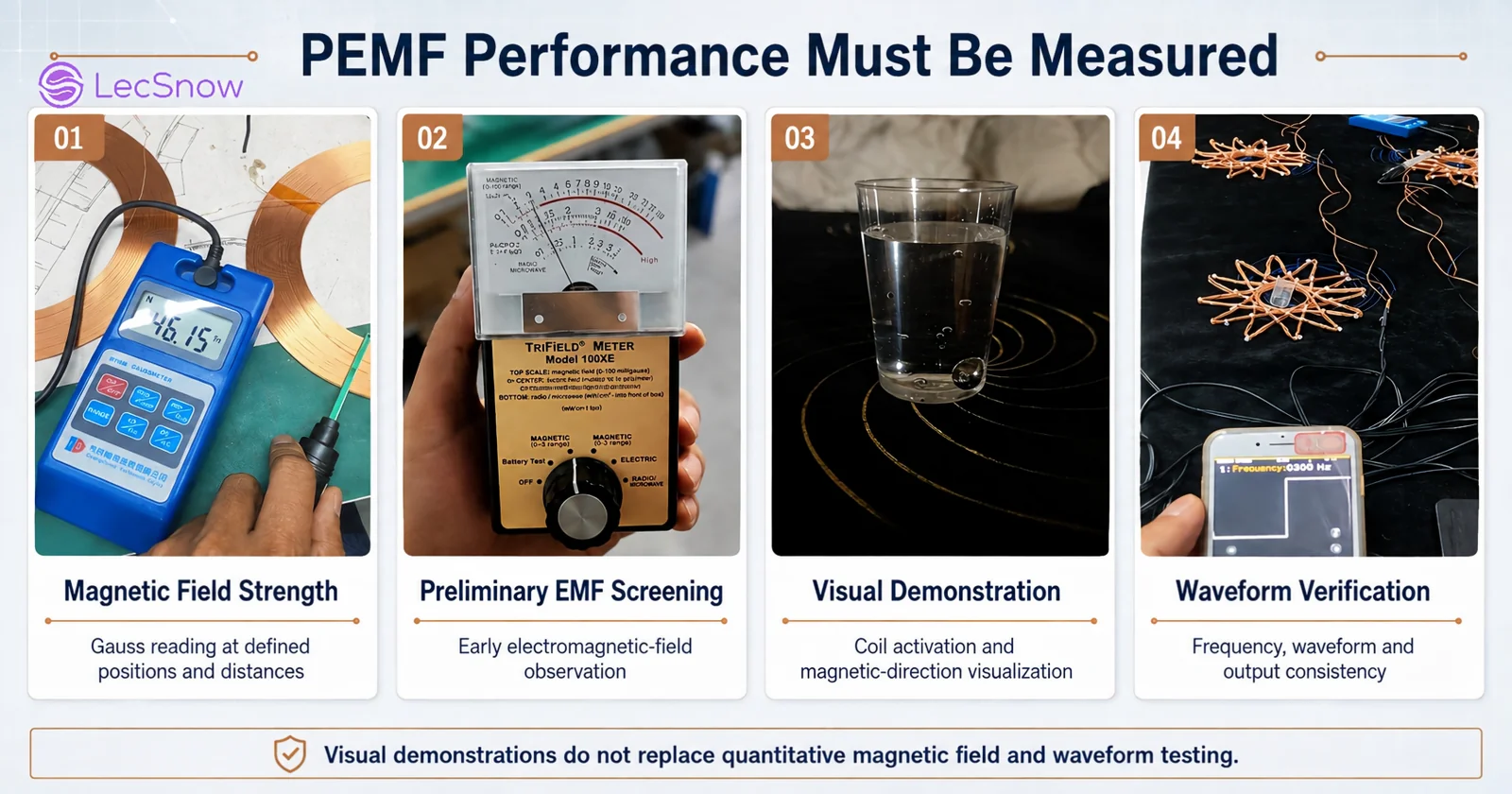
A Gauss meter can be used to test each coil. The record should identify the instrument, product program, intensity, frequency, waveform, measurement position, distance and power conditions. Multi-coil products should be measured at several locations, including coil centers, edges and areas between coils. Distribution testing helps reveal weak zones and inconsistencies that a single maximum reading may conceal.
Appropriate equipment should verify actual frequency, waveform type, pulse width, duty cycle, rise and fall characteristics and output consistency at different intensity levels. Where slew rate is a defined project requirement, it should be measured using an agreed method rather than estimated only from nominal frequency and Gauss output.
Internal electromagnetic-field screening can help identify abnormal emissions during engineering development. Formal EMC verification, however, requires calibrated laboratory equipment and applicable market standards. Magnetic balls or similar objects can visualize coil activation or direction, but they do not prove field strength, waveform accuracy or health effects.
LecSnow PEMF development testing: magnetic field strength, preliminary emission screening, visual magnetic-direction demonstration and waveform verification.
Certification requirements depend on the target market, electrical architecture, communication functions and intended product claims. They should be defined before the controller, adapter and enclosure are finalized—not added after engineering is complete.
For the European Economic Area, CE marking is a manufacturer declaration that the product meets all applicable EU legal requirements; it is not simply one certificate purchased from a laboratory. For a general wellness PEMF product, the applicable framework may include the EMC Directive 2014/30/EU, RoHS Directive 2011/65/EU and other legislation depending on voltage, radio functions, materials and intended use. EMC testing evaluates electromagnetic emissions and immunity, while RoHS restricts specified hazardous substances in electrical and electronic equipment.
For the United States, FCC requirements depend on whether the product contains only digital circuitry as an unintentional radiator or includes Wi-Fi, Bluetooth or another intentional transmitter. Unintentional radiators commonly follow the applicable Supplier’s Declaration of Conformity pathway, while intentional radiators generally require FCC equipment certification. Adding app or wireless control can therefore change the compliance route.
CE-EMC, RoHS and FCC compliance do not authorize medical claims. If a brand intends to position a PEMF product for diagnosis, treatment or another medical purpose, the regulatory pathway must be assessed separately for the target market. The product specification, claims and test plan should remain aligned throughout development.
A well-planned platform can support full-body mats, PEMF mattresses, sitting mats, portable recovery mats, localized pads, head or neck applicators, arm and leg products, pet beds and equine blankets. Sharing controller logic, design language, materials, connectors and parts of the technical platform creates more leverage than developing unrelated products independently.
This planning should happen before the first wholesale PEMF recovery mat is finalized. Early decisions about connectors, channel capacity, software and coil architecture may either support or restrict future product expansion.
A PEMF mat for dogs OEM project should not simply reduce the dimensions of a human mat. Pet products may need protected cables, wipe-clean surfaces, removable covers, anti-slip materials, safer controller placement and optional gravity-sensing activation. Rectangular kennel mats, round beds and targeted pads support different animal behaviors and usage environments.
For horses, coverage area, attachment method, cable protection, portability, moisture resistance and durability in stable environments become more important. An equine PEMF mat manufacturer must design around the animal, handler and operating environment—not only the electromagnetic specification.
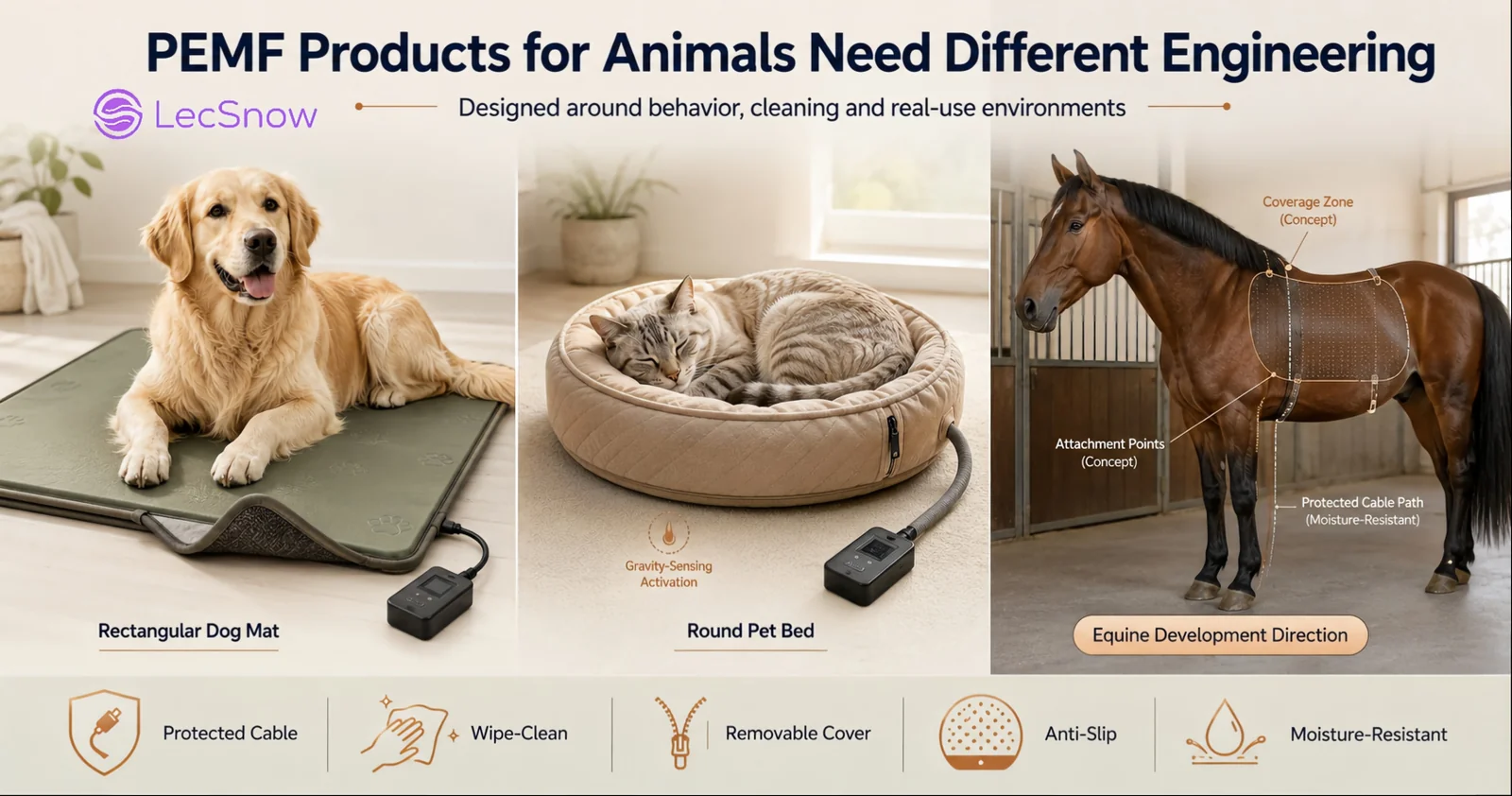
LecSnow Pemf therapy mat for animals engineering
A unique prototype has commercial value only when it can be reproduced reliably. Coil winding, resistance, position, controller output and finished-product performance need defined tolerances and inspection methods. Otherwise, units from the same batch may deliver different results.
A structured PEMF therapy mat OEM project should move through:
LecSnow’s current PEMF therapy mat platform supports adjustable frequency, magnetic intensity, session settings, multiple mat dimensions and configurable coil and waveform systems. Customization can extend to the controller, programs, materials, structure, packaging and targeted applicators for human, pet and equine use.
Before investing in tooling, certification or a production order, send us your target market, intended application, reference products, required field strength, preferred frequency and waveform, product format, target price and expected quantity.
Whether launching your first product or scaling your next bestseller, LecSnow is here to bring your vision to life faster, smarter, and without compromise.