A spec-sheet buyer’s guide for B2B beauty brands and distributors: set your wavelength and irradiance floor, read supplier specs like an engineer, verify IEC 62471 eye safety, spot red flags, and choose OEM or ODM.

Choosing an LED face mask manufacturer is a sourcing decision, and the fastest way to get it wrong is to shop by the brochure. A mask is a photobiomodulation device, which means its value sits in measured wavelength accuracy, delivered irradiance, and eye safety, not in how many colors a render shows. The brands that launch a credible mask treat the supplier conversation as an engineering review, not a logo swap.
This guide follows that order. It shows how to set your spec floor from the outcome you plan to claim, how to read a supplier's spec sheet like an engineer, which test reports to actually ask for, the red flags that warn you before a bad batch ships, and how to match the right manufacturing model to your launch. For teams evaluating an LED face mask manufacturer, the question is whether the partner can specify the light correctly and document it for the markets you sell into.
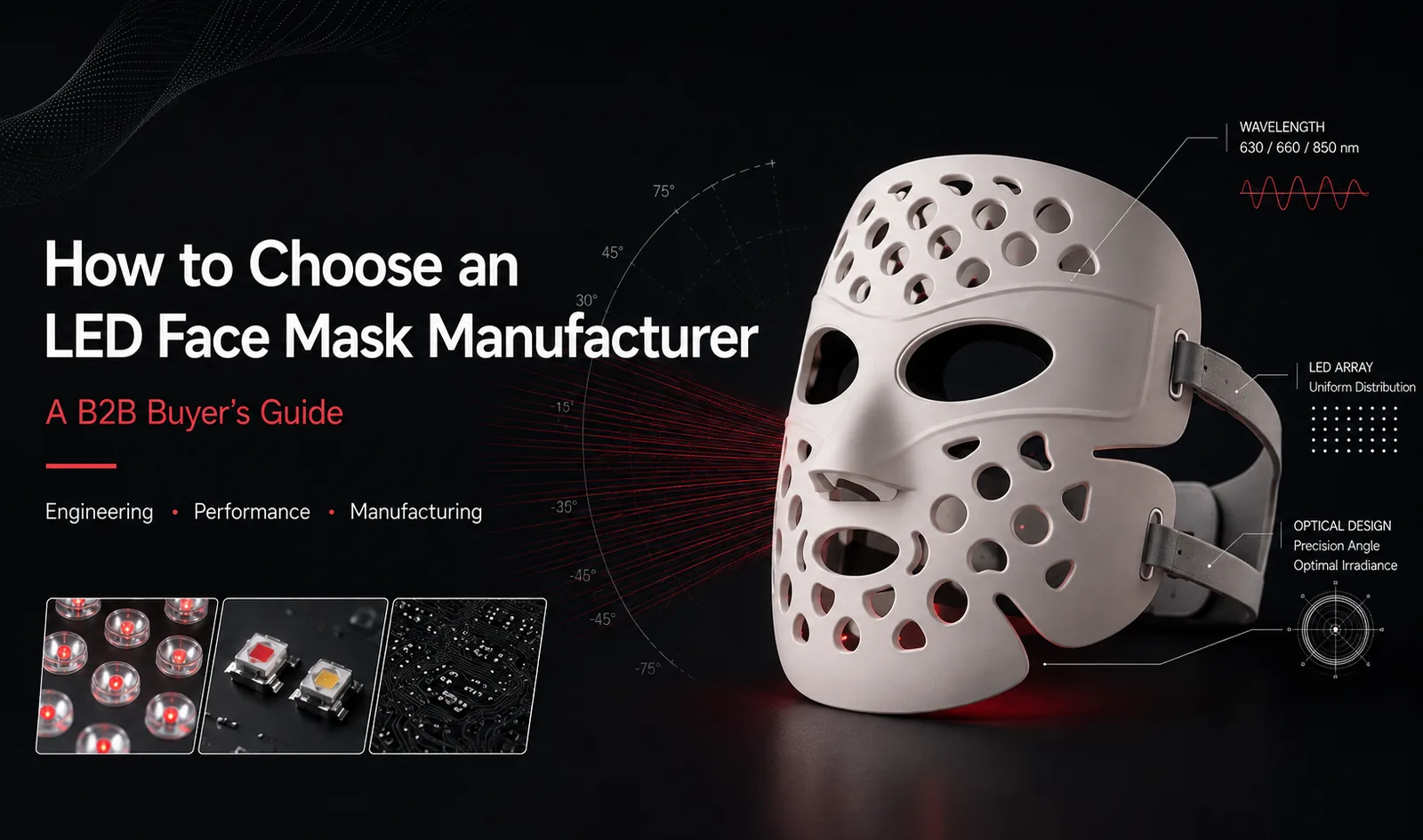
A spec-sheet-first approach to choosing an LED face mask manufacturer.
Before you ask a supplier for a quote, fix what the mask is supposed to do and where you will sell it. Those two decisions set every specification that follows.
A brand targeting firmness and tone typically builds around red (roughly 630 to 660 nm) and near infrared (around 830 to 850 nm), the bands most associated with collagen related skin appearance. A brand aimed at surface concerns adds blue (about 415 to 460 nm) as a separate mode. The wavelengths you choose drive the safety case, because a device worn close to the eyes triggers photobiological safety obligations that a wrist wearable never sees.
Your target market changes the testing and the label. That is covered in the reports section; first, learn to read the numbers on the spec sheet like an engineer.
This is the section that protects your launch. A spec sheet is only as good as the numbers behind it, so learn to read the four values that separate a real device from a toy.
Wavelength accuracy and tolerance. A stated 660 nm diode that is actually 680 nm lands on a different part of the absorption curve, and the cellular response drops. High grade diodes hold within about ±5 nm of the target band. Ask for a spectral report from a spectrometer, not a marketing sheet, because tolerance is exactly where cheap diodes fail.
Measured irradiance. Irradiance is the light energy actually reaching the skin, expressed in milliwatts per square centimeter. Strong masks sit in a useful band (competitors cite roughly 25 to 100 mW/cm2 at the skin), and the number should come from a calibrated measurement, not a peak power claim. Consumer solar power meters can inflate readings two to three times, so insist on a lab grade spectral irradiance report.
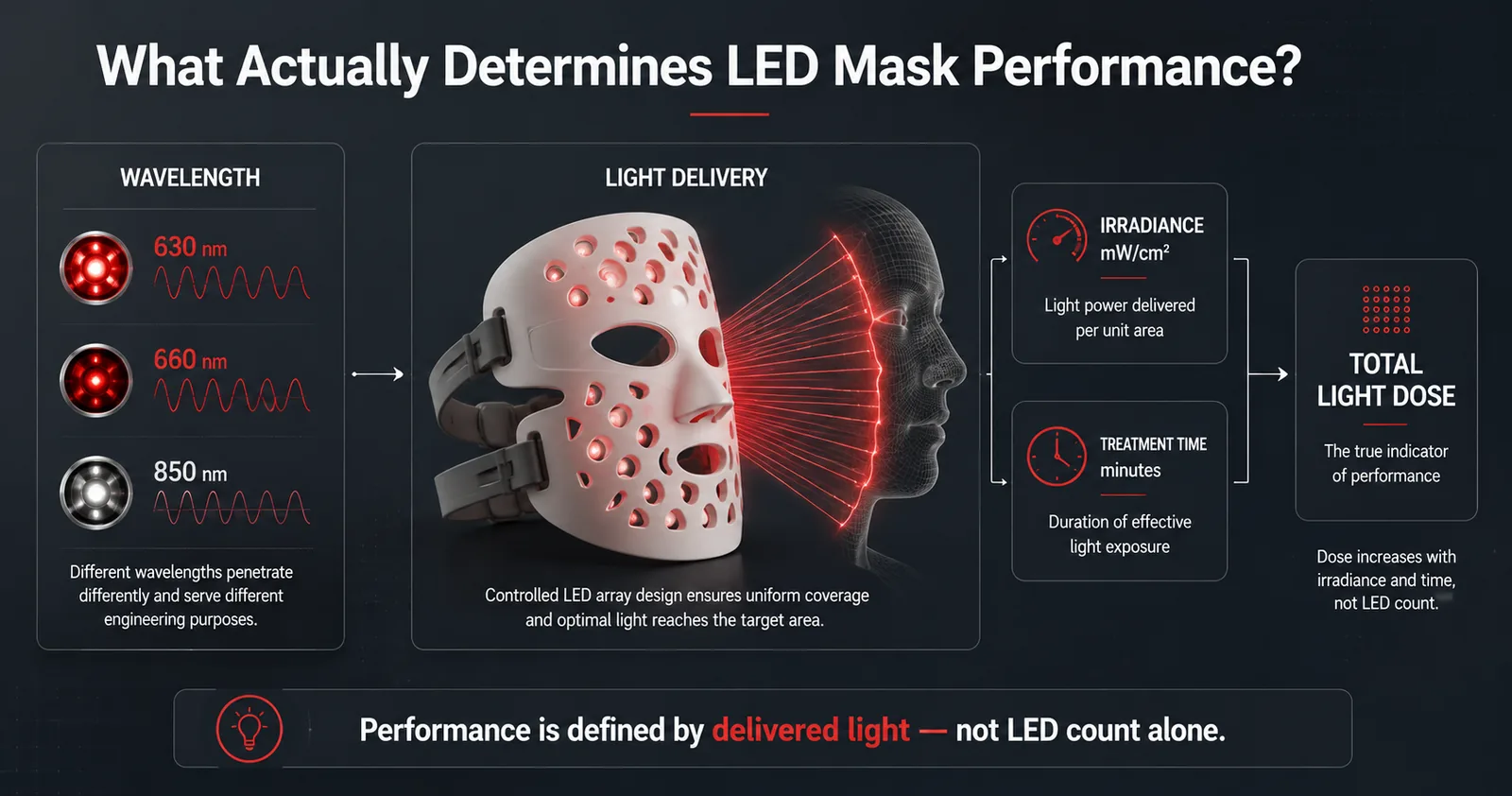
Wavelength accuracy and measured irradiance are the two numbers that separate a real device from a toy.
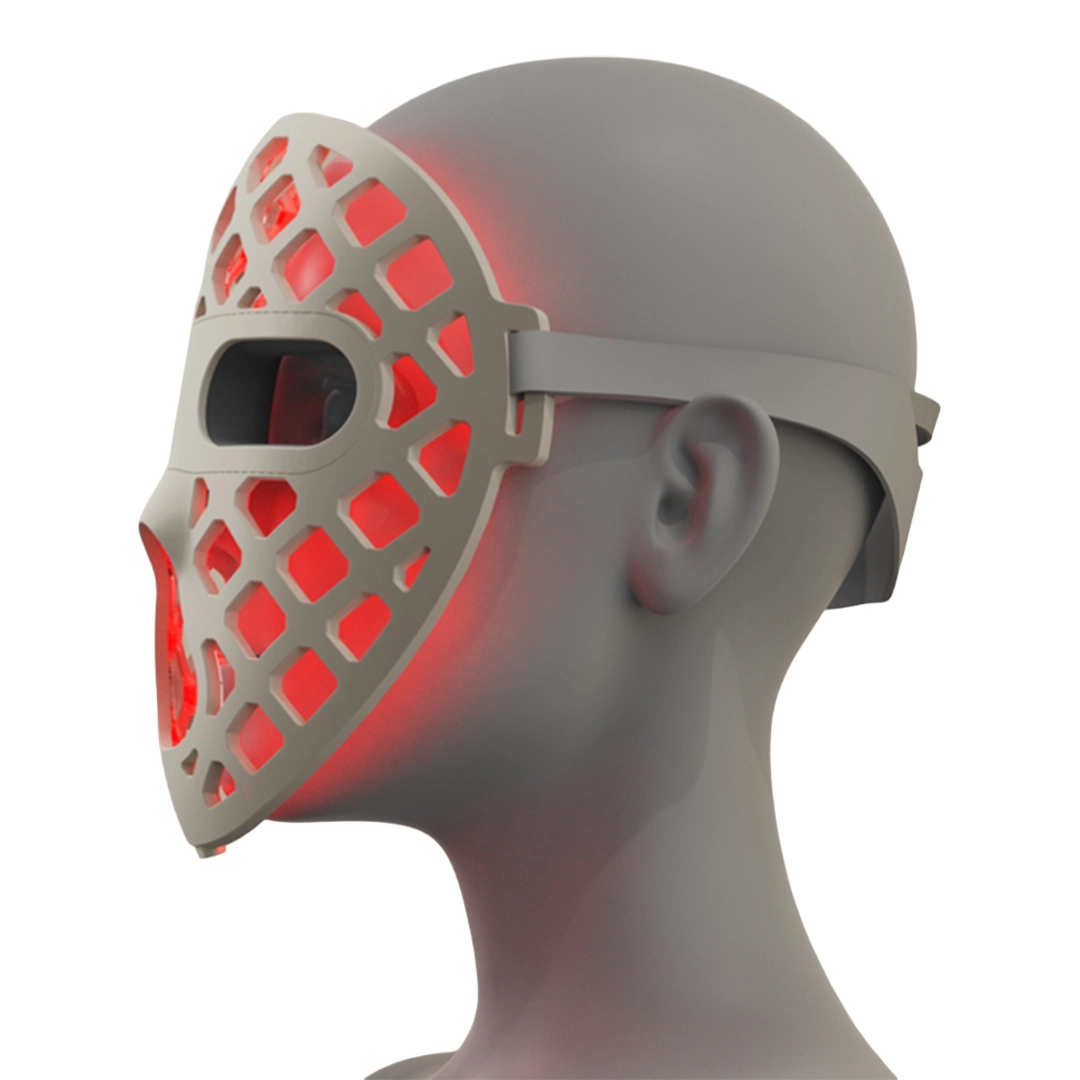
LED density and coverage. More LEDs only help if they are placed to cover the face evenly. Premium consumer masks use 130 to 240 plus LEDs; what matters is uniform delivery across the cheeks and forehead, not a headline count.
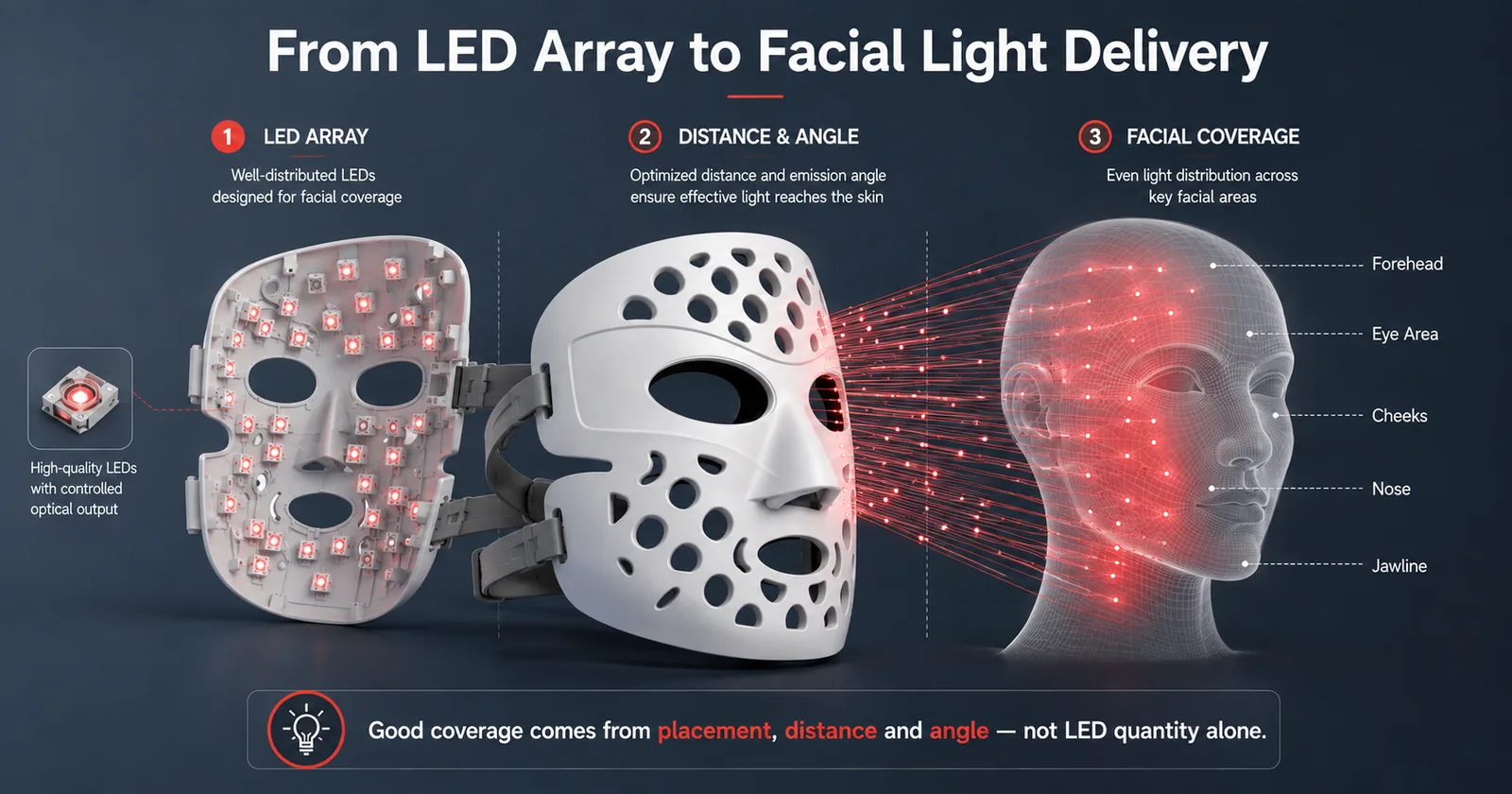
Even LED placement across the cheeks and forehead avoids hot and dead spots.
Eye safety to IEC 62471. Because the mask sits close to the eyes, a photobiological safety report to IEC 62471 is not optional, and blue light needs explicit retinal safety documentation. A supplier that cannot produce that file is not ready for regulated markets, regardless of how the mask looks in a render.
Thermal and electrical stability. LEDs lose roughly 10 to 15 percent of output as they heat, so weak heat dissipation dims the mask mid session. Stable, firmware driven output and even distribution are the details a real engineering partner talks about unprompted.
| Specification | Why it matters | What good looks like |
|---|---|---|
| Wavelength tolerance | Determines biological response | Within about ±5 nm of the stated band |
| Measured irradiance | Decides whether light reaches skin | Lab graded mW/cm2, not solar meter estimates |
| LED density and coverage | Avoids hot and dead spots | Even delivery, 130 plus LEDs typical |
| IEC 62471 eye safety | Required for a device near the eyes | Photobiological report plus blue light retinal data |
| Thermal stability | Prevents output drop during use | Stable output across a full session |
Once the physics checks out, confirm the supplier can actually hand you the paperwork that belongs to the product. This is where vague claims quietly become your liability, and it matters more than a long list of certificates on a brochure.
The one report that matters most for this category is IEC 62471. Because the mask sits against the face, photobiological safety and blue light retinal data are the difference between a product you can ship near the eyes and one you cannot. Ask for the actual test file, not a sentence in a catalog.
Market documents come second. For the US, treatment claims pull a product into the FDA pathway, and a facility that is merely "FDA Registered" is only listed in a database, not cleared. For the EU, consumer LED masks sold on cosmetic or skin-care claims today reach the market through self-declared CE conformity (low-voltage, EMC, RoHS, REACH) plus that same IEC 62471 report. Ask which entity holds each document, and never accept a self-printed CE logo as proof. The exact requirements shift by market and by claim, so confirm with the supplier what they can provide for your target region before you commit.
Material grade is practical, not ceremonial. Skin-contact silicone should be medical or food grade, and adhesives should meet the same bar. You do not need a wall of certificates to ask for that; you need the material specification in writing.
Documentation discipline. The right partner hands you the spectral report, the irradiance map, the IEC 62471 file, and the bill of materials without being chased. That paper trail is what clears customs and what protects you if a claim is ever questioned.
The cost of a weak supplier shows up after launch, not during the pitch. Watch for these signals before you commit.
- "FDA Registered" presented as approval. Registration is a listing, not clearance. Treat it as a non answer.
- Vague wavelength and irradiance. A supplier that answers "red, blue, infrared" without nanometers, tolerance, or a measurement method cannot prove performance.
- No third party report. If the only evidence is a marketing PDF, you are carrying the risk.
- No per unit test. Serious production ages every unit for several hours at full power. Skipping this pushes failure rates into your returns.
- Overpromised results. A supplier that guarantees dramatic wrinkle or acne cures for a consumer mask is creating compliance exposure you will own.
The last step is structural. Your goal, speed, and budget decide whether OEM or ODM fits.
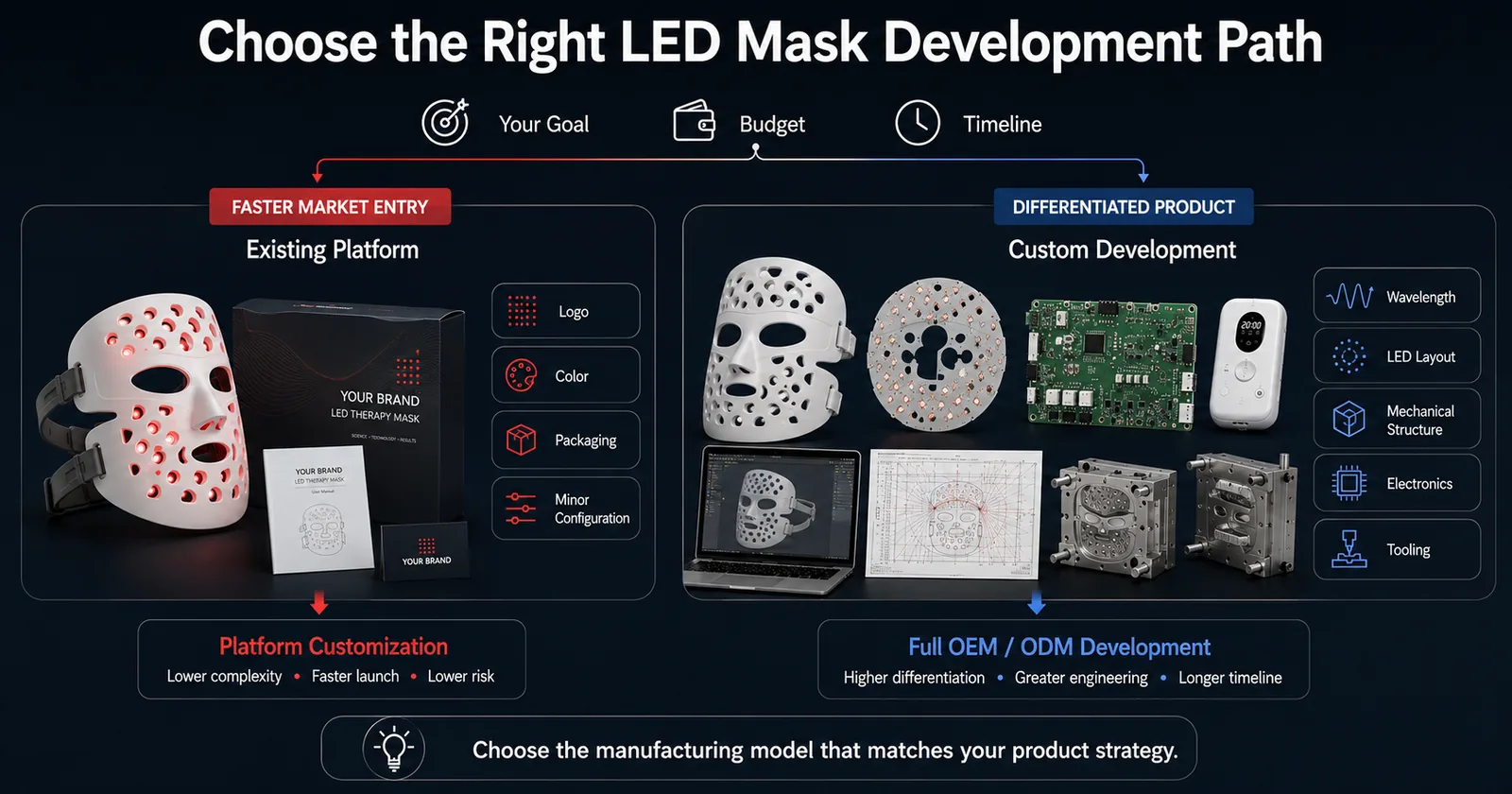
OEM versus ODM: match the model to your goal, speed, and budget.
Choose ODM when you want to reach market fast on a proven platform and mainly need branding, packaging, and minor configuration. Choose OEM when you bring a defined concept, wavelengths, and form factor, and need the supplier to build to your spec. Custom silicone molds cost more to set up than a standard shell, so MOQ and tooling should match your volume plan.
Protect the relationship with the basics: a signed NDA, defined IP and tooling ownership, sample stress tests before mass production, and a clear plan for reorder and after sales. The engineering partner you want talks in nanometers and milliwatts, shows the reports, and raises eye safety before you do.
LecSnow develops and supplies LED face masks across multiple form factors, and two current examples show what brands build on. The ultra-light hollow LED therapy facial mask pairs a 193 g hollow structure with four wavelengths (850 nm NIR, 630 nm red, 590 nm amber, 415 nm blue) and medical-grade silicone. The 6-color LED facial mask carries 240 LEDs across six wavelengths for brands that want full-spectrum positioning. The variables this guide tells you to verify, wavelength accuracy, measured irradiance, and IEC 62471 eye safety, are exactly what LecSnow builds into its development process, with OEM and ODM paths and regional documentation support.
Choosing an LED face mask manufacturer is a decision you make once per product line, and it should be gated on light and proof, not just labels. Set the outcome, read the spec sheet like an engineer, ask for the right reports, avoid the red flags, then pick the model that fits your launch.
Common questions buyers ask
What minimum order quantity should I expect? OEM rebrands often start at a few hundred units, while ODM programs need higher volume to justify tooling and engineering. Confirm the MOQ for your chosen form factor.
Can a supplier help with market documentation? A capable partner can prepare the test reports and basic documentation you need, including the IEC 62471 eye-safety file, CE and FCC paperwork, and material specifications, then point you to the right pathway for your market. The final regulatory responsibility usually sits with the brand, so ask upfront which documents the supplier can issue under your entity.
How do I stop a supplier from reselling my ODM design? Address it in the contract through IP ownership, design file and firmware control, and an exclusivity clause for your markets. Without that language, a supplier can offer your developed product to the next inquirer.
How do I verify a supplier before a full order? Request the spectral report, irradiance measurement, and IEC 62471 eye safety file, then run a pilot batch to check output consistency and build quality. Close the loop with a commissioned inspection and reference checks from brands in your target markets.
Glass GE. Photobiomodulation: A Systematic Review of the Oncologic Safety of Low-Level Light Therapy for Aesthetic Skin Rejuvenation. Aesthet Surg J. 2023. https://pubmed.ncbi.nlm.nih.gov/36722207/
IEC 62471 photobiological safety of lamps and lamp systems. https://webstore.iec.ch/publication/7076
Whether launching your first product or scaling your next bestseller, LecSnow is here to bring your vision to life faster, smarter, and without compromise.