A category-first buyer guide for beauty and wellness brands: define the body care device format, evaluate each technology by its role, verify evidence and compliance, then choose a private label or ODM manufacturing model that fits your market.

Choosing a private label body care device manufacturer should start with a different question: what product are you actually trying to build?
For a beauty or wellness brand targeting skin firmness, the appearance of cellulite or body toning, a wearable EMS belt, a waterproof handheld device and a compact multi-technology device are not interchangeable. They create different treatment experiences, require different engineering controls and fit different consumer routines.
For procurement teams, product managers, engineers and founders, a more useful evaluation sequence is: consumer concern → product format → technology architecture → measurable performance → evidence and compliance → manufacturing capability. The manufacturer should be evaluated against that sequence, not simply by catalog size, function count or unit price.
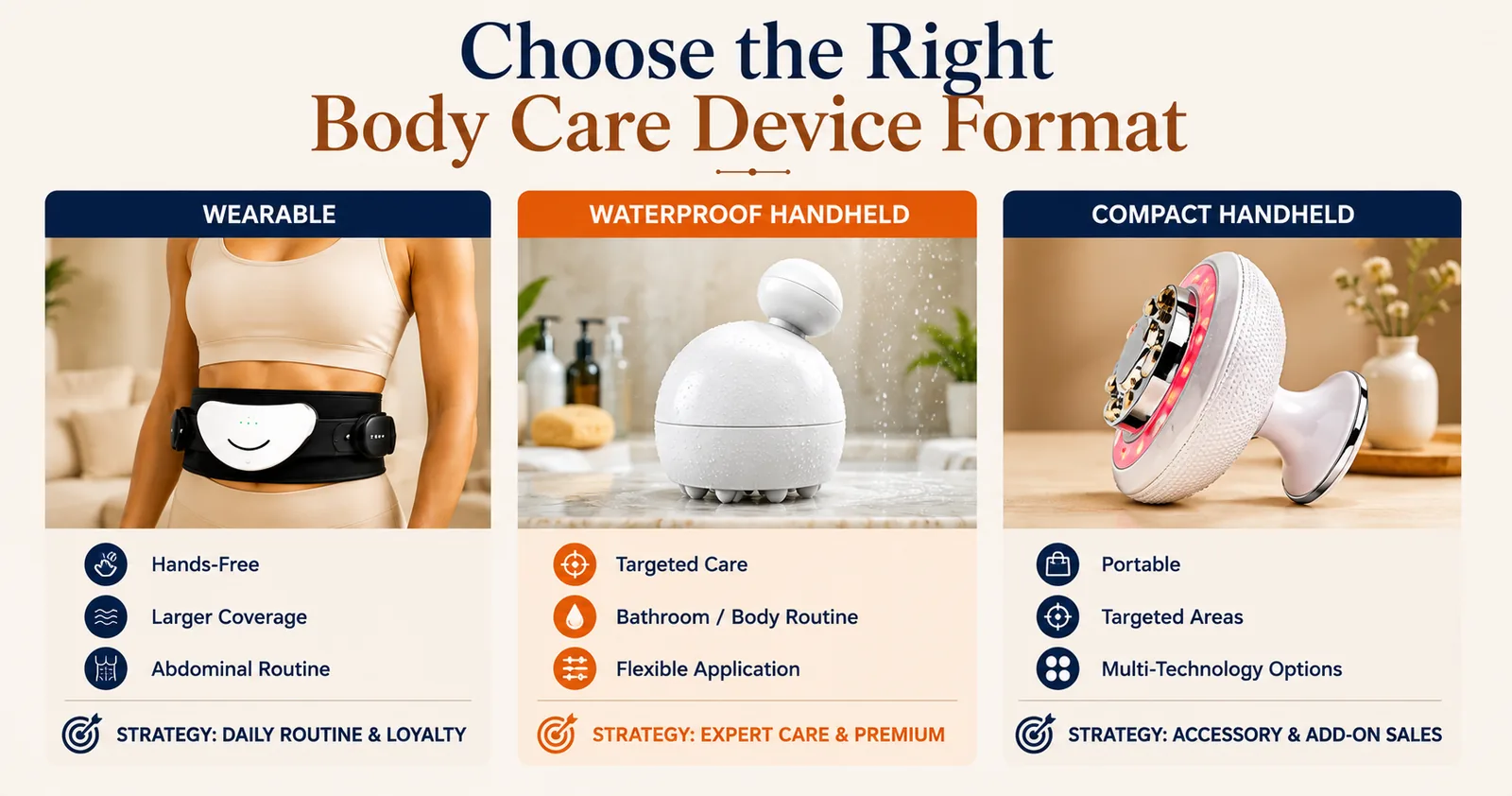
Wearable, waterproof handheld, and compact handheld body care device formats compared for private label manufacturing
Before requesting quotations, define what the product needs to accomplish from the consumer’s point of view. “Anti-cellulite device” is too broad for product development. A useful brief should distinguish between improving the appearance of cellulite, supporting firmer-looking skin, muscle stimulation and body toning, localized body care, use with body formulas, or hands-free abdominal care.
These objectives do not automatically require the same technology or format. The U.S. FDA treats non-invasive body contouring as a broad category covering different intended effects, including changes in muscle tone or firmness and improvement in the appearance of cellulite. It also states that non-invasive body contouring is not a treatment for obesity and should not be positioned as weight loss.[1]
A skincare-led brand may need a device that fits naturally beside a body serum or firming cream. A fitness-oriented brand may emphasize muscle stimulation and hands-free use. A premium beauty brand may prioritize localized treatment, industrial design and a controlled multi-technology experience.
A handheld body care device gives users control over the treatment area, making it suitable for localized routines on areas such as the abdomen, thighs, hips and upper arms. It can also fit naturally into a routine using a compatible conductive gel or body formula.
A waterproof handheld format creates a different use case: localized body care integrated into the bathroom or shower routine. Waterproofing is therefore not just a marketing feature; it changes sealing, charging, material and verification requirements.
A wearable device solves another problem: coverage and hands-free use. For abdominal care, belt fit, electrode position and contact consistency can matter more than adding another technology to the specification sheet.
Before comparing suppliers, define where consumers will use the device, which body areas they will treat, whether use is handheld or hands-free, whether a topical formula is involved, and what sensation the user should perceive. Those decisions should determine the architecture.
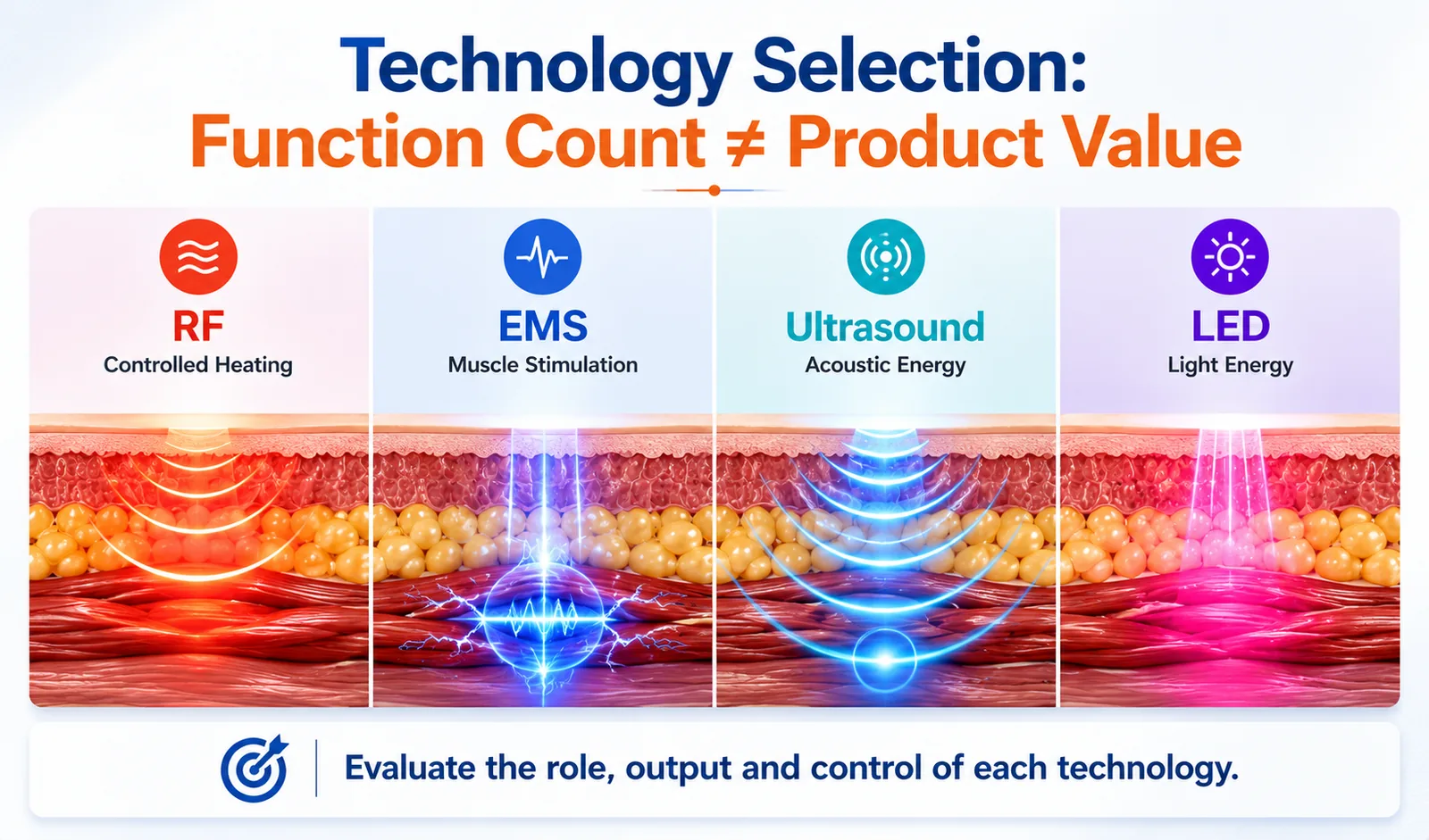
RF, EMS, ultrasound and LED body care technologies compared by mechanism and role in device development
More technologies do not automatically create a better product. RF + EMS + ultrasound + LED may look stronger on a marketing page, but each technology needs a defined role, appropriate output, suitable contact and a reason to exist in the consumer routine.
Radiofrequency (RF) used in aesthetic body-care devices is an energy-based technology intended to generate controlled tissue heating. The FDA notes that authorized RF body-contouring procedures may temporarily improve the appearance of cellulite or make skin look or feel tighter, while also identifying risks such as discomfort, redness, swelling, blisters and burns.[1]
A systematic review of randomized controlled trials reported promising findings for radiofrequency among cellulite interventions, but those results came from specific devices and protocols and should not be generalized to every home-use RF product.[2]
For buyers, the relevant questions are RF frequency and output architecture, temperature monitoring or control, electrode design, skin-contact requirements, treatment area and shut-off logic. The finished product’s own data matters more than evidence borrowed from another RF platform.
EMS electrically stimulates muscles and can create perceptible muscle contractions depending on the device and program. The FDA states that EMS devices may temporarily strengthen, tone or firm muscles, while noting that it has not cleared EMS devices for weight loss or girth reduction.[3]
Important engineering questions include waveform, frequency range, intensity levels, electrode dimensions and positioning, contact detection and how intensity changes during a program. “Strong EMS” is marketing language; waveform and electrode logic are engineering information.
Ultrasound is used across very different aesthetic and therapeutic systems. Reviews have reported body-contouring and cellulite-related outcomes for particular ultrasound devices and protocols,[4] but frequency, acoustic output, treatment duration and application method vary considerably. Do not transfer evidence from a clinical platform to a compact home-use product simply because both specifications say “ultrasound.”
For LED, wavelength alone is not enough. Buyers should ask for wavelength, irradiance at the treatment surface, coverage, treatment distance and program duration before building efficacy claims around the function.
The broader rule is simple: do not evaluate a body care device by how many technologies are printed on the box. Evaluate what each technology contributes, how it is controlled and whether the finished device can demonstrate that performance.
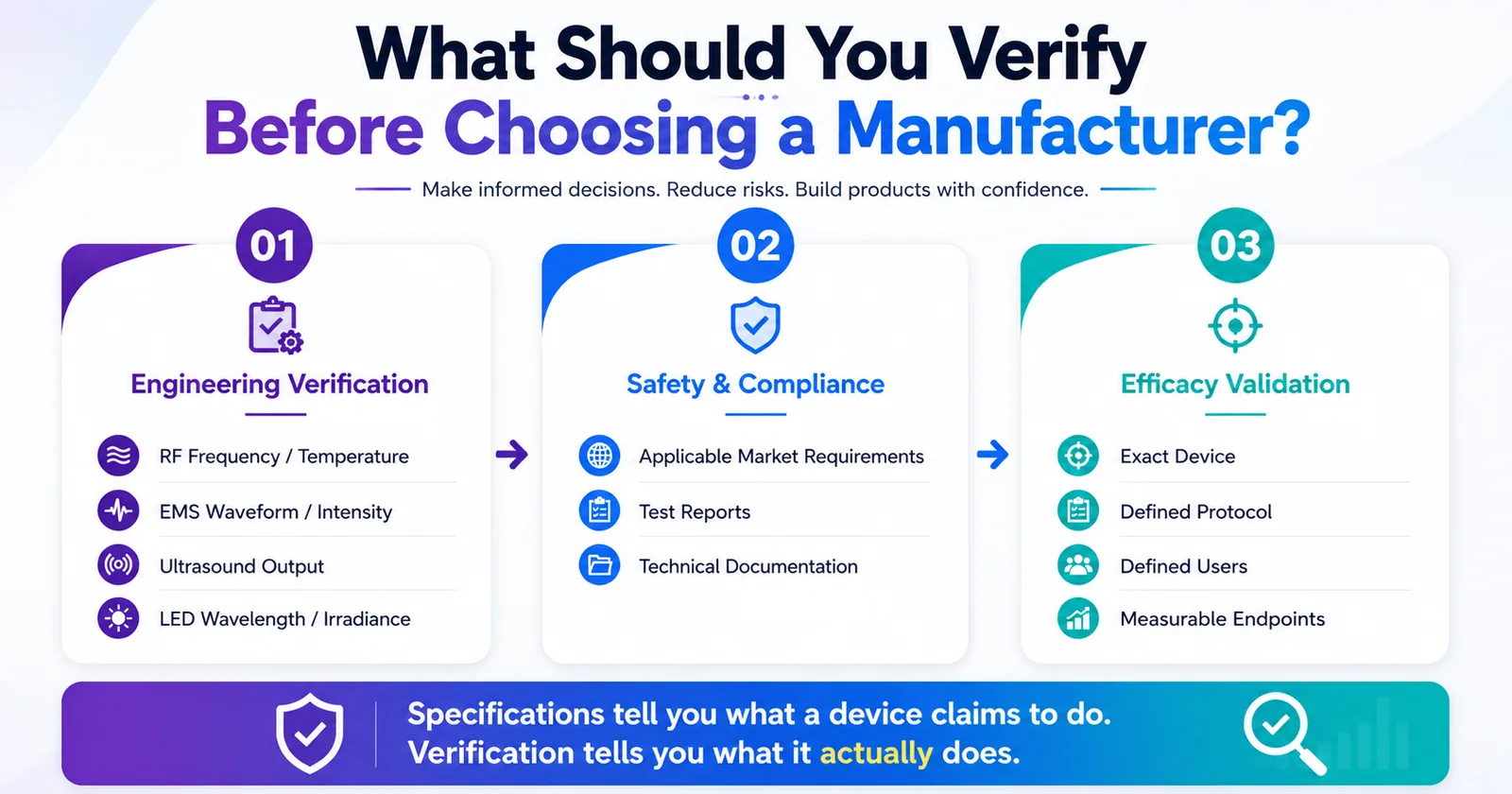
Engineering verification, safety and compliance, and efficacy validation checklist for choosing a body care device manufacturer
A serious private label body care device manufacturer should be able to move the conversation from benefits to evidence. Depending on the platform, useful verification may include RF frequency and thermal control, EMS waveform and frequency, ultrasound output, LED wavelength and irradiance, battery performance, waterproof testing, temperature rise and operating consistency.
Engineering verification asks whether the finished device produces the specified output consistently. Safety and compliance testing asks whether the product meets applicable requirements for its intended market and use. Efficacy or consumer-use testing asks whether a defined user group following a defined protocol shows change against defined endpoints.
For skin-firming or cellulite-appearance positioning, study design may use standardized photography, validated cellulite grading, instrumental skin measurements or imaging where appropriate. A recent systematic review on ultrasound imaging for cellulite also emphasized substantial protocol heterogeneity and the need for greater standardization.[5]
For the EU, CE marking is not simply a certificate purchased from a laboratory. The applicable legislation must be identified, conformity assessed, technical documentation prepared and an EU Declaration of Conformity issued where required. The European Commission states that manufacturers are responsible for ensuring conformity and maintaining the relevant documentation.[6]
For the United States, avoid treating every requirement as one generic “certificate.” An RF skin-firming or body-care device may fall under FDA medical-device requirements depending on its intended use, claims and technical characteristics. Separately, electrical/electronic products may have other applicable requirements based on their configuration. The correct regulatory route should therefore be assessed for the exact product and claims rather than inferred from the term “RF.”
Before mass production, ask which regulations and standards apply to the exact configuration, which reports already exist, whether they match the quoted hardware and firmware, what customization triggers retesting, and which marketing claims can actually be supported.
A good sample does not prove a good production system. Review incoming inspection, in-process controls, functional and aging tests, waterproof verification where relevant, batch traceability and non-conforming product handling. For ODM, also assess electronics, firmware, industrial design, structure, tooling and validation capability. What happens when the first prototype does not work as expected often reveals more than the first quotation.
After the technical and manufacturing filters are passed, decide how deeply the product should be customized. For brands testing a category, private label may be sufficient: an existing platform with logo, color, packaging and manual localization. For brands requiring stronger differentiation, OEM/ODM can extend into function combinations, energy programs, firmware, industrial design, structure, accessories and a new product platform.
At LecSnow, we prefer to treat product form as a strategic decision rather than recommend three similar devices from a catalog. Each platform below serves a different consumer routine.
| Product strategy | Best fit | LecSnow platform |
|---|---|---|
| Wearable / hands-free | Abdominal care, larger coverage and muscle-stimulation routines | Waist Sculpting Belt |
| Waterproof handheld | Localized body care integrated into bathroom or body-care routines | Handheld Body Shaping Device |
| Compact multi-technology handheld | Portable targeted care with flexible technology combinations | RES Skin Contouring Beauty Device |
These are not three versions of the same product. They represent three different product strategies. The right choice depends on treatment area, consumer routine, desired sensation, technology role, target price and evidence plan.
That is ultimately how a private label body care device manufacturer should help a B2B buyer make a decision: not by pushing the model with the longest feature list, but by determining which platform, technology combination, verification plan and customization level fit the brand’s consumer, market and commercial model.
If an existing platform already fits, private label can be the fastest and lowest-risk route. If it does not, the next step may be parameter modification, structural customization or full ODM development.
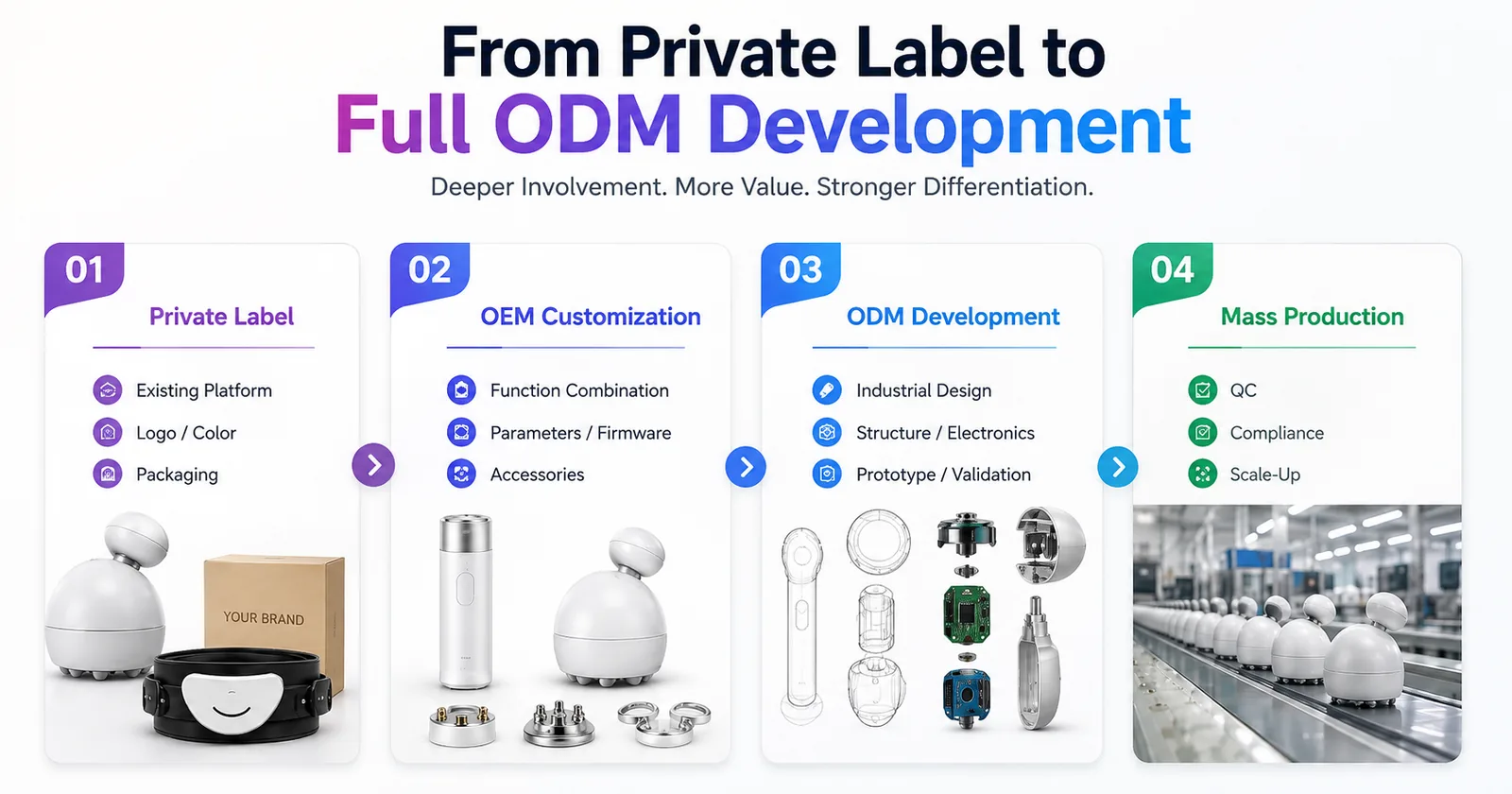
Private label, OEM customization, ODM development and mass production roadmap for body care devices
[1] U.S. Food and Drug Administration. Non-Invasive Body Contouring Technologies. https://www.fda.gov/medical-devices/aesthetic-cosmetic-devices/non-invasive-body-contouring-technologies
[2] Comparative Analysis of Cellulite Treatment Modalities: A Systematic Review. Randomized controlled trial evidence across cellulite treatment modalities.
[3] U.S. Food and Drug Administration. Electronic Muscle Stimulators. https://www.fda.gov/medical-devices/consumer-products/electronic-muscle-stimulators
[4] Juhász M, Korta D, Atanaskova Mesinkovska N. A Review of the Use of Ultrasound for Skin Tightening, Body Contouring, and Cellulite Reduction in Dermatology.
[5] Intagliata D, Garo ML. The Role of Ultrasound in the Diagnosis and Treatment of Cellulite: A Systematic Review. 2026.
[6] European Commission. CE Marking: Manufacturers. https://europa.eu/youreurope/business/product-requirements/labels-markings/ce-marking/
Whether launching your first product or scaling your next bestseller, LecSnow is here to bring your vision to life faster, smarter, and without compromise.