EMS, RF and ultrasound each play a different role in at-home body contouring. Compare benefits, limits and sourcing trade-offs to choose the right technology for your brand.

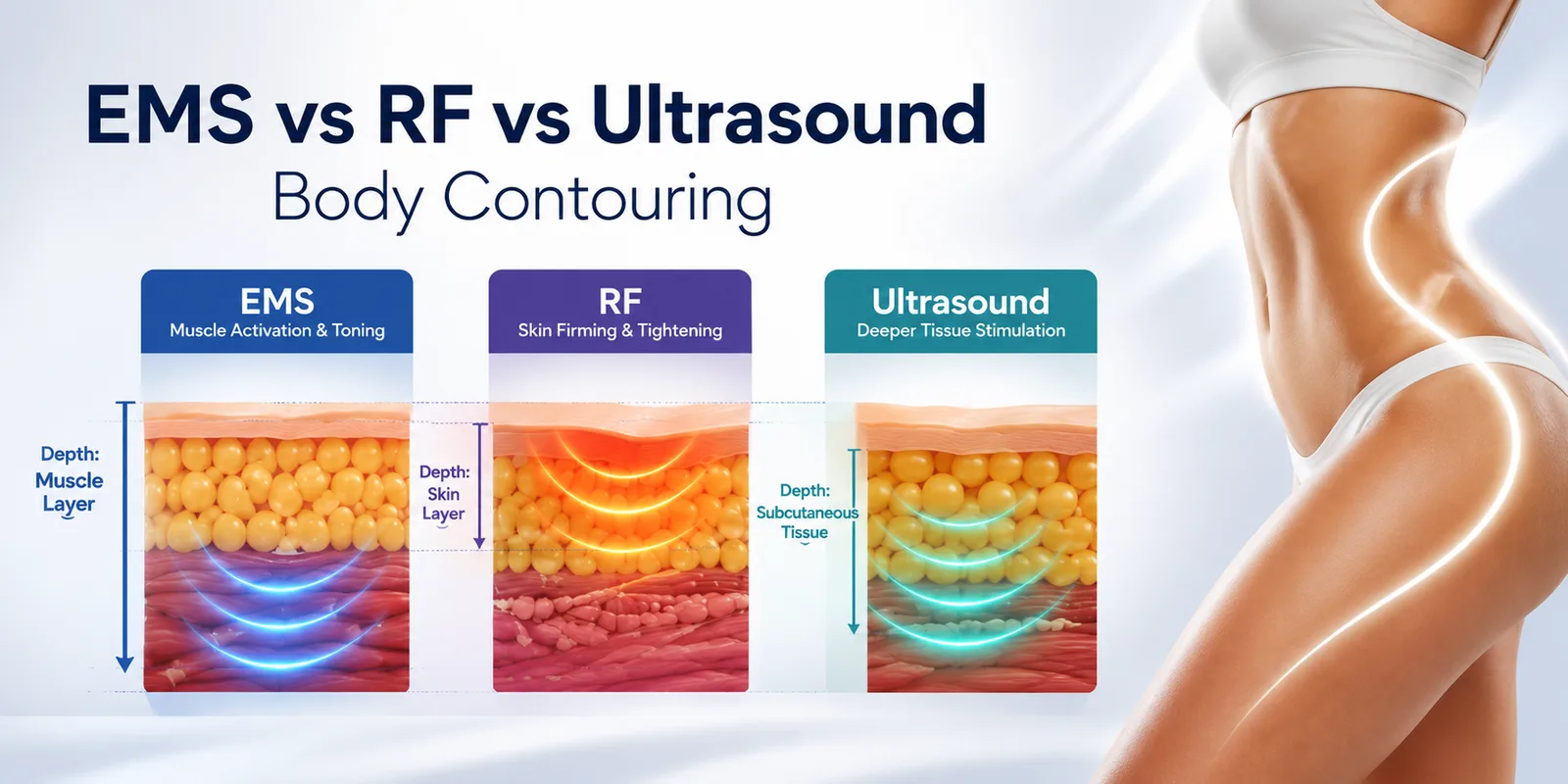
EMS, RF and ultrasound each play a different role in body contouring. EMS is mainly used for muscle activation and toning, RF for skin firming through controlled heat, and ultrasound for deeper mechanical stimulation and body contouring support. For beauty brands, the best choice depends on the consumer result you want to build around, the product format, user experience, price positioning and the level of evidence needed for your target market.
Beauty brands rarely struggle because they cannot find enough technologies to add to a body contouring product. The real challenge is deciding which technology best fits the product they want to build and the consumer need they want to own.
A brand focused on muscle toning may choose a very different platform from one focused on skin firming, smoother-looking skin or broader body care. And for brands considering a wearable multi-technology product, the goal should not simply be to add more functions, but to make each technology serve a clear purpose.
For example, LecSnow's Waist Sculpting Belt combines EMS, 500kHz ultrasound and light-based body care in a wearable format. It is a useful example of how several technologies can be brought together around one body-care routine rather than treated as separate features.
| Technology | Main Role | Best Suited For | Typical User Experience | Key Product Consideration |
|---|---|---|---|---|
| EMS | Muscle stimulation | Toning, muscle activation, core-focused body care | Noticeable muscle contractions | Electrode placement, skin contact, waveform, intensity and comfort |
| RF | Controlled thermal energy | Skin firming, tightening appearance, texture improvement | Gradual warmth or heat | Temperature control, sensors, treatment time and thermal safety |
| Ultrasound | Mechanical vibration and deeper tissue stimulation | Body contouring support, tissue care and selected shaping applications | Vibration, warmth or deeper treatment sensation depending on design | Frequency, power, transducer design, contact and treatment area |
The important point is that these technologies should not be treated as three versions of the same solution.
They work differently, feel different in use and fit different product positioning strategies.
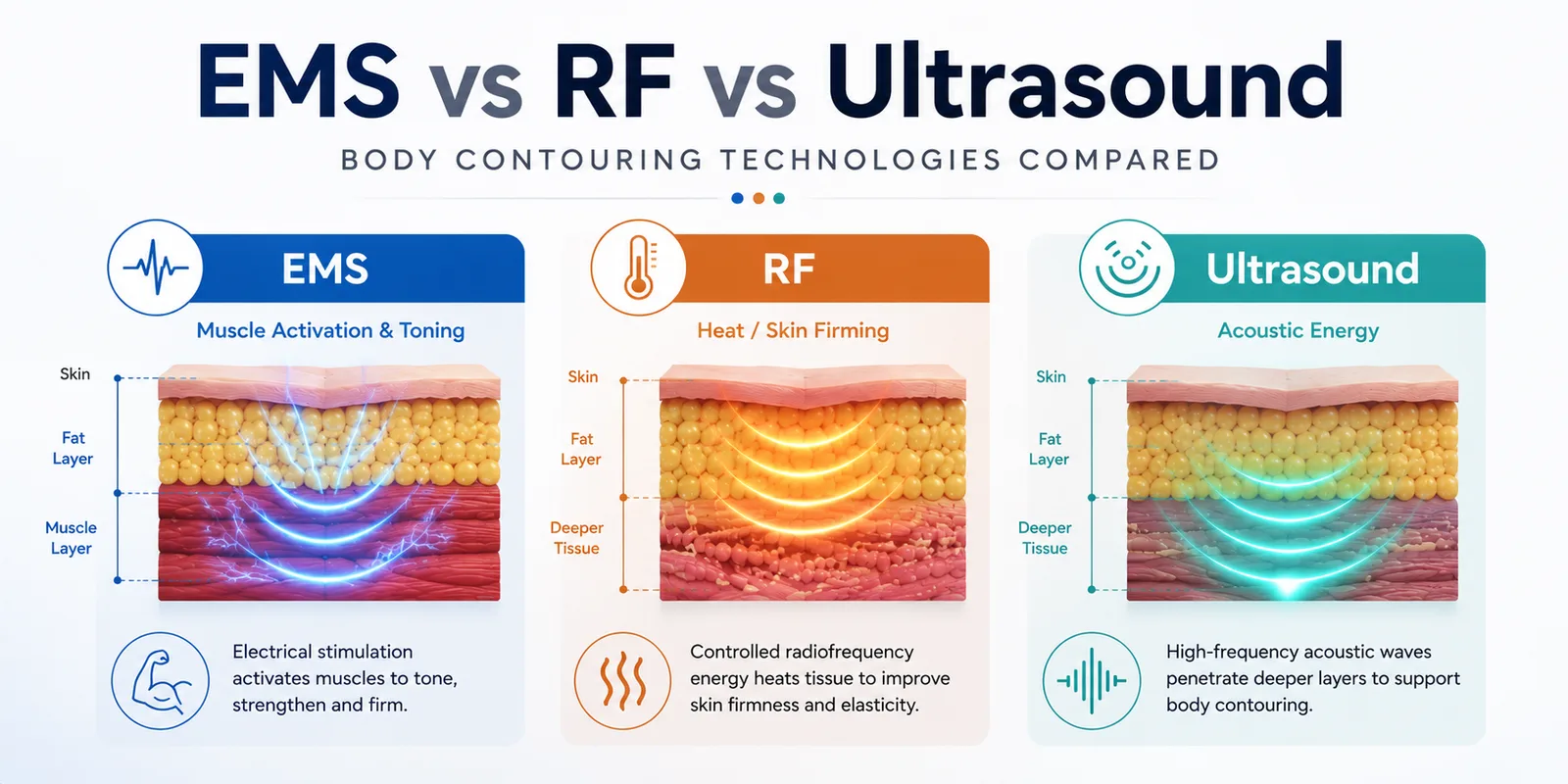
EMS uses electrical stimulation to trigger muscle contractions. For body care products, this makes it particularly relevant when muscle activation, toning and a more defined body feel are central to the concept.
From a product-development perspective, EMS performance is not determined by frequency alone. Electrode placement, waveform, current intensity, program design and skin contact all influence how the product feels and how consistently users experience it.
This is especially important in wearable products. A belt may need to fit different waist sizes, body shapes and activity levels while maintaining reliable electrode contact and comfortable stimulation.
For brands, EMS is therefore a strong choice when the product story is built around tone, activate and support muscle engagement. a 2023 systematic review of EMS
RF uses radiofrequency energy to create controlled heating in tissue. In aesthetic body care, it is commonly associated with skin firming, tightening appearance and improvements in skin texture. FDA's overview of non-invasive body contouring technologies
For product managers, the appeal of RF is clear when the consumer problem is more about skin quality than muscle activation.
A body-care brand targeting loose-looking skin, post-weight-loss firmness or smoother-looking body skin may therefore find RF more aligned with its product story than EMS.
But RF also creates a different engineering challenge. Temperature sensing, energy control, treatment time and thermal safety become central to the user experience.
The goal is not simply to create more heat. It is to deliver a controlled and repeatable treatment that consumers can use comfortably at home.
Ultrasound works differently from both EMS and RF. It uses acoustic energy to create mechanical vibration and, depending on the system, thermal effects within tissue.
In body-care products, ultrasound is commonly used to support deeper tissue stimulation, massage-like treatment, circulation-oriented body care and selected body contouring applications. a 2025 systematic review on ultrasound body contouring
For product managers, the key question is not whether ultrasound “works” in general, but what role it is intended to play in the specific product.
A 500kHz ultrasound system, for example, may be selected for deeper mechanical stimulation and body-care support within a wearable or handheld device. Other ultrasound systems, including focused ultrasound used in professional treatments, are designed around very different power levels and treatment goals.
This is why ultrasound should be evaluated as a product platform rather than as a single universal technology.
Frequency, power, transducer design, treatment area, coupling and contact all influence how the system behaves and what kind of user experience it can support.
For brands, ultrasound can be particularly interesting when the product concept calls for a deeper, more massage-oriented or multi-layer body-care experience rather than muscle stimulation alone.
There is no single best option.
If the main goal is muscle activation and toning, EMS is usually the most natural starting point.
If the product is centered on skin firming, tightening appearance or thermal body care, RF may be the stronger fit.
If the concept calls for deeper mechanical stimulation, tissue care or a broader body contouring experience, ultrasound can provide a different role from both EMS and RF. FDA guidance on non-invasive body contouring
The choice should therefore begin with one question:
What consumer problem do you want the product to solve first?
Only after that should the brand decide whether one technology is enough or whether a combination creates a stronger product.
A multi-technology device makes sense when each technology has a clear role.
For example:
• EMS can support muscle activation.
• Ultrasound can add deeper mechanical stimulation.
• Light therapy can support skin and recovery-focused body care.
The commercial value is not simply being able to say “three technologies in one device.”
The value comes from creating one clear routine with several complementary functions.
This is the logic behind LecSnow's Waist Sculpting Belt, which combines EMS, 500kHz ultrasound and light-based body care in a wearable format.
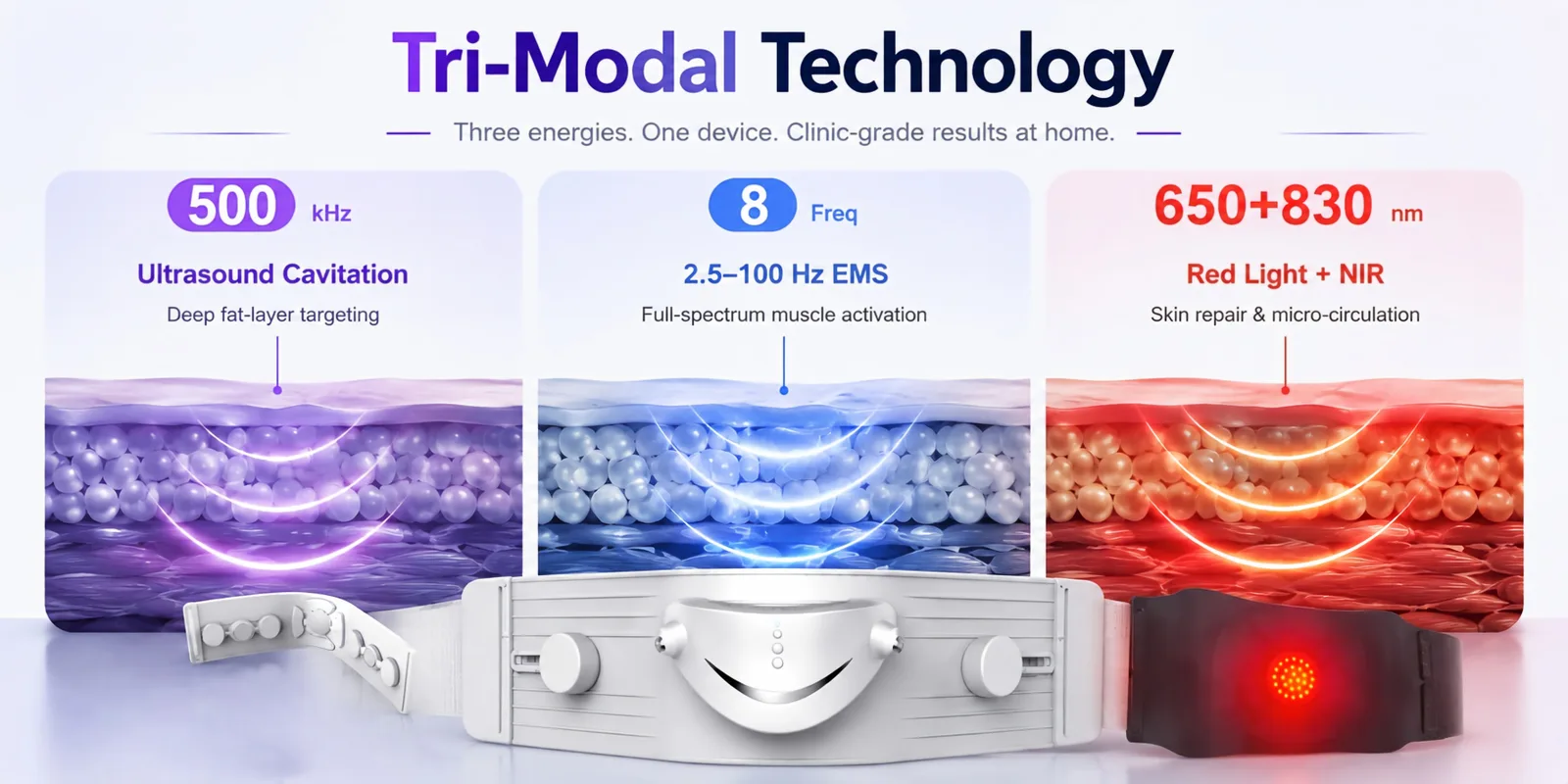
For brands, the more important question is not how many technologies are included, but whether the combination creates a product story that consumers can easily understand and consistently use.
Technology choice is only one part of product development.
Before finalizing the platform, brands should also consider:
• Consumer goal: Is the product mainly about toning, firming, cellulite appearance, relaxation or broader body care?
• Product format: Wearable belt, handheld device or professional-style platform?
• User experience: Heat, muscle contraction, vibration, fit, comfort and treatment time.
• Price positioning: Entry-level single-function device or premium multi-technology platform?
• Evidence and compliance: What claims can realistically be supported in the intended market?
• Development complexity: More technologies usually mean more work in hardware, controls, testing and certification.
This is where product strategy matters more than feature count.
For OEM/ODM projects, LecSnow's custom manufacturing process covers technology selection, program design, industrial design, engineering, testing and certification support as part of one development process. LecSnow's custom manufacturing process
No. They serve different body care goals. RF is primarily used for controlled heating and skin firming, while EMS focuses on muscle stimulation and toning. The better choice depends on what your brand wants the product to achieve and how consumers are expected to use it.
Not necessarily. Ultrasound covers a wide range of technologies and applications. In home-use body-care products, it may be used for deeper mechanical stimulation, massage-oriented treatment or broader body contouring support, depending on the product design and operating parameters.
Only when the combination creates a clearer or more complete user benefit. Adding more technologies can increase cost and development complexity, so each function should have a defined role in the product experience.
A brand should review the main technical specifications, program behavior, fit range, battery performance, temperature or stimulation behavior where relevant, cleaning instructions, inspection standards and any design changes that could affect the final product.
EMS, RF and ultrasound are not competing versions of the same technology.
They are tools for different product goals.
EMS is strongest when the concept is built around toning and muscle activation. RF is more naturally aligned with firming and thermal skin care. Ultrasound adds a deeper mechanical body-care dimension and can play an important role in multi-technology body contouring products.
The strongest product usually starts with a clear consumer need first, then selects the technology that best supports it.
If you are evaluating EMS, RF, ultrasound or a multi-technology platform for a new at-home body care product, LecSnow can help review the technology combination, product structure and development direction around your target market and positioning. contact LecSnow
• FDA: Non-Invasive Body Contouring Technologies: https://www.fda.gov/medical-devices/aesthetic-cosmetic-devices/non-invasive-body-contouring-technologies
• 2025 Systematic Review of HIFU in Skin Tightening and Body Contouring: https://pubmed.ncbi.nlm.nih.gov/40184185/
• Review of Non-Invasive Body Contouring Technologies: https://pubmed.ncbi.nlm.nih.gov/37957393/
• HIFEM With and Without RF: Systematic Review
• Waist Sculpting Belt: https://www.lecsnow.com/shop/product-information/waist-sculpting-belt
• Custom manufacturing process: https://www.lecsnow.com/solutions
• Discuss Your Body Care Device Project with LecSnow: https://www.lecsnow.com/contact
Whether launching your first product or scaling your next bestseller, LecSnow is here to bring your vision to life faster, smarter, and without compromise.